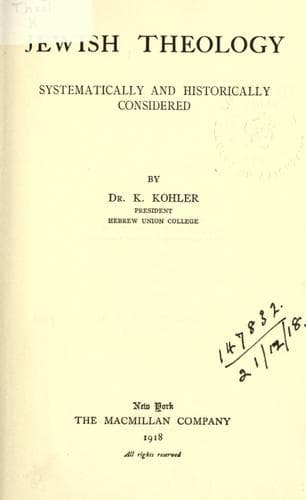
Jewish Theology, Systematically and Historically ConsideredKohler, Kaufmann
Religion
Jewish Theology, Systematically and Historically Considered
Kohler, Kaufmann
Judaism -- Doctrines
4. At the first encounter of Judaism with those philosophical schools of
Hellas which denied the freedom of the human will, the Jewish teachers
insisted strongly on this principle. The first reference is found in Ben
Sira, who refutes the arguments of the Determinists that God could make
man sin, and then goes on: “God created man at the beginning, endowing him
with the power of self-determination, saying to him: If thou but willest,
thou canst observe My commandments; to practice faithfulness is a matter
of free will.... As when fire and water are put before thee, so that thou
mayest reach forth thy hand to that which thou desirest, so are life and
death placed before man, and whatever he chooses of his own desire will be
given to him.”(713) The Book of Enoch voices this truth also in the
forceful sentences: “Sin has not been sent upon the earth (from above),
but men have produced it out of themselves; therefore they who commit sin
are condemned.”(714) We read similar sentiments in the Psalms of Solomon,
a Pharisean work of the first pre-Christian century:(715) “Our actions are
the outcome of the free choice and power of our own soul; to practice
justice or injustice lies in the work of our own hands.”
The Apocalypse of Ezra is especially instructive in the great stress which
it lays on freedom, in connection with its chief theme, the sinfulness of
the children of Adam. “This is the condition of the contest which man who
is born on earth must wage, that, if he be conquered by the evil
inclination, he must suffer that of which thou hast spoken (the tortures
of hell), but if he be victorious, he shall receive (the reward) which I
(the angel) have mentioned. For this is the way whereof Moses spoke when
he lived, saying unto the people, ‘Choose life, that thou mayest live!’...
For all who knew Me not in life when they received My benefits, who
despised My law when they yet had freedom, and did not heed the door of
repentance while it was still open before them, but disregarded it, after
death they shall come to know it!”(716)
Public-domain text, read in full here on John Shaqi.
Reviews
Reviews
No reviews yet
Be the first to share your thoughts on this work.
Elsewhere in the archive
Join the Discussion
Join the discussion
Sign in to leave a comment or review.
Sign InorCreate an account