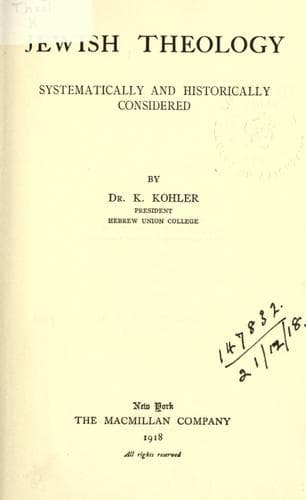
Jewish Theology, Systematically and Historically ConsideredKohler, Kaufmann
Religion
Jewish Theology, Systematically and Historically Considered
Kohler, Kaufmann
Judaism -- Doctrines
Chapter XXXVII. Free Will and Moral Responsibility
1. Judaism has ever emphasized the freedom of the will as one of its chief
doctrines. The dignity and greatness of man depends largely upon his
freedom, his power of self-determination. He differs from the lower
animals in his independence of instinct as the dictator of his actions. He
acts from free choice and conscious design, and is able to change his mind
at any moment, at any new evidence or even through whim. He is therefore
responsible for his every act or omission, even for his every intention.
This alone renders him a moral being, a child of God; thus the moral sense
rests upon freedom of the will.(706)
2. The idea of moral freedom is expressed as early as the first pages of
the Bible, in the words which God spoke to Cain while he was planning the
murder of his brother Abel: “Whether or not, thou offerest an acceptable
gift,” (New Bible translation: “If thou doest well, shall it not be lifted
up? and if thou doest not well,”) “sin coucheth at the door; and unto thee
is its desire, but thou mayest rule over it.”(707) Here, without any
reference to the sin of Adam in the first generation, the man of the
second generation is told that he is free to choose between good and evil,
that he alone is responsible before God for what he does or omits to do.
This certainly indicates that the moral freedom of man is not impaired by
hereditary sin, or by any evil power outside of man himself. This
principle is established in the words of Moses spoken in the name of God:
“I have set before thee life and death, the blessing and the curse;
therefore choose life, that thou mayest live, thou and thy seed.”(708) In
like manner Jeremiah proclaims in God’s name: “Behold I set before you the
way of life and the way of death.”(709)
3. From these passages and many similar ones the sages derived their
oft-repeated idea that man stands ever at the parting of the ways, to
choose either the good or the evil path.(710) Thus the words spoken by God
to the angels when Adam and Eve were to be expelled from Paradise:
“Behold, the man is become as one of us, to know good and evil,” are
interpreted by R. Akiba: “He was given the choice to go the way of life or
the way of death, but he chose the way of death by eating of the forbidden
fruit.”(711) R. Akiba emphasizes the principle of the freedom of the will
again in the terse saying: “All things are foreseen (by God), but free
will is granted (to man).”(712)
Public-domain text, read in full here on John Shaqi.
Reviews
Reviews
No reviews yet
Be the first to share your thoughts on this work.
Elsewhere in the archive
Join the Discussion
Join the discussion
Sign in to leave a comment or review.
Sign InorCreate an account