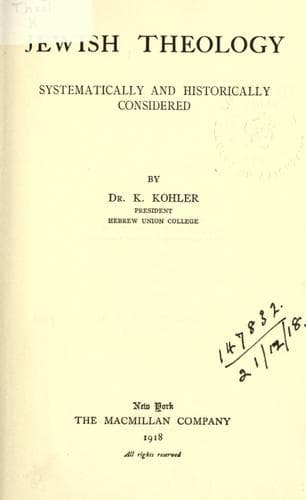
Jewish Theology, Systematically and Historically ConsideredKohler, Kaufmann
Religion
Jewish Theology, Systematically and Historically Considered
Kohler, Kaufmann
Judaism -- Doctrines
1. Sin is a religious conception. It does not signify a breach of law or
morality, or of popular custom and sacred usage, but an offense against
God, provoking His punishment. As long as the deity is merely dreaded as
an external power, not adored as a moral power ruling life from within for
a holy purpose, sin, too, is considered a purely formal offense. The deity
demands to be worshiped by certain rites and may be propitiated by other
formal acts.(732) For Judaism, however, sin is a straying from the path of
God, an offense against the divine order of holiness. Thus it signifies an
abuse of the freedom granted man as his most precious boon. Therefore sin
has a twofold character; formally it is an offense against the majesty of
God, whose laws are broken; essentially it is a severance of the soul’s
inner relations to God, an estrangement from Him.
2. Scripture has three different terms for sin, which do not differ
greatly in point of language, but indicate three stages of thought. First
is _het_ or _hataah_, which connotes any straying from the right path,
whether caused by levity, carelessness, or design, and may even include
wrongs committed unwittingly, _shegagah_. Second is _avon_, a crookedness
or perversion of the straight order of the law. Third is _pesha_, a wicked
act committed presumptuously in defiance of God and His law. As a matter
of course, the conception of sin was deepened by degrees, as the prophets,
psalmists and moralists grew to think of God as the pattern of the highest
moral perfection, as the Holy One before whom an evil act or thought
cannot abide.
The rabbis usually employed the term _aberah_, that is, a transgression of
a divine commandment. In contrast to this they used _mitzwah_, a divine
command, which denotes also the whole range of duty, including the desire
and intention of the human soul. From this point of view every evil design
or impulse, every thought and act contrary to God’s law, becomes a sin.
Public-domain text, read in full here on John Shaqi.
Reviews
Reviews
No reviews yet
Be the first to share your thoughts on this work.
Elsewhere in the archive
Join the Discussion
Join the discussion
Sign in to leave a comment or review.
Sign InorCreate an account