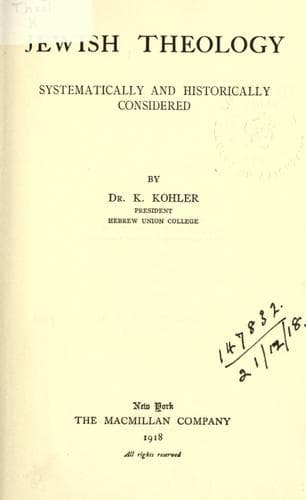
Jewish Theology, Systematically and Historically ConsideredKohler, Kaufmann
Religion
Jewish Theology, Systematically and Historically Considered
Kohler, Kaufmann
Judaism -- Doctrines
3. Sin arises from the weakness of the flesh, the desire of the heart, and
accordingly in the first instance from an error of judgment. The Bible
frequently speaks of sin as “folly.”(733) A rabbinical saying brings out
this same idea: “No one sins unless the spirit of folly has entered into
him to deceive him.”(734) A sinful imagination lures one to sin; the
repetition of the forbidden act lowers the barrier of the commandment,
until the trespass is hardened into “callous” and “stubborn” disregard,
and finally into “reckless defiance” and “insolent godlessness.” Such a
process is graphically expressed by the various terms used in the Bible.
According to the rabbinical figure, “sin appears at first as thin as a
spider’s web, but grows stronger and stronger, until it becomes like a
wagon-rope to bind a man.” Or, “sin comes at first as a passer-by to tarry
for a moment, then as a visitor to stay, finally as the master of the
house to claim possession.” Therefore it is incumbent upon us to “guard”
the heart, and not “to go astray following after our eyes and our
heart.”(735)
4. According to the doctrine of Judaism no one is sinful by nature. No
person sins by an inner compulsion. But as man has a nature of flesh,
which is sensuous and selfish, each person is inclined to sin and none is
perfectly free from it. “Who can say: I have made my heart clean, I am
pure from any sin?”(736) This is the voice of the Bible and of all human
experience; “For there is not a righteous man upon earth, that doeth good,
and sinneth not.”(737) The expression occurs repeatedly in Job: “Shall
mortal man be just before God? Shall a man be pure before his Maker?”(738)
Even Moses is represented in numerous passages as showing human foibles
and failings.(739) In fact, “the greater the personality, the more
severely will God call him to account for the smallest trespass, for God
desires to be ‘sanctified’ by His righteous ones.”(740) The Midrash tells
us that no one is to be called holy, until death has put an end to his
struggle with the ever-lurking tempter within, and he lies in the earth
with the victor’s crown of peace upon his brow.(741) When we read the
stern sentence: “Behold, He putteth no trust in His holy ones,”(742) the
rabbis refer us to the patriarchs, each of whom had his faults.(743)
Measured by the Pattern of all holiness, no human being is free from
blemish.
Public-domain text, read in full here on John Shaqi.
Reviews
Reviews
No reviews yet
Be the first to share your thoughts on this work.
Elsewhere in the archive
Join the Discussion
Join the discussion
Sign in to leave a comment or review.
Sign InorCreate an account