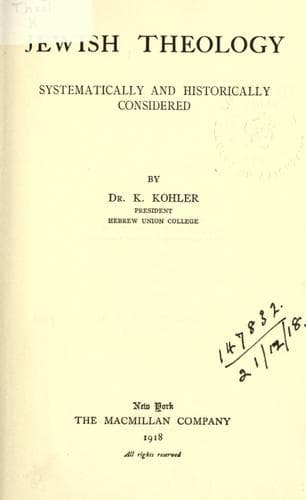
Jewish Theology, Systematically and Historically ConsideredKohler, Kaufmann
Religion
Jewish Theology, Systematically and Historically Considered
Kohler, Kaufmann
Judaism -- Doctrines
5. In connection with the God-idea, the conception of sin grew from crude
beginnings to the higher meaning given it by Judaism. The ancient
Babylonians used the same terminology as the Bible for sin and
sin-offering, but their view, like that of other Semites, was far more
external.(744) If one was afflicted with disease or misfortune, the
inference was that he had neglected the ritual of some deity and must
appease the angered one with a sacrificial offering. Any irregularity in
the cult was an offense against the deity. This became more moralized with
the higher God-idea; the god became the guardian of moral principles; and
the calamities, even of the nation, were then ascribed to the divine wrath
on account of moral lapses. The same process may be observed in the views
of ancient Israel. Here, too, during the dominance of the priestly view
the gravest possible offense was one against the cult, a culpable act
entailing the death penalty—_asham_, or “doom” of the offender. We shudder
at the thought that the least violation of the hierarchical rules for the
sanctuary or even for the burning of incense should meet the penalty of
death. Yet such is the plain statement of the Mosaic law and such was the
actual practice of the people.(745)
The more the prophetic conception of the moral nature of the Deity
permeated the Jewish religion, the more the term sin came to mean an
offense against the holiness of God, the Guardian of morality. Hence the
great prophets upbraided the people for their moral, not their ceremonial
failings. They attacked scathingly transgressions of the laws of
righteousness and purity, the true sins against God, because these
originate in dullness of heart, unbridled passion, and overbearing pride,
all so hateful to Him. The only ritual offenses emphasized as sins against
God are idolatry, violation of the name of God and of the Sabbath, for
these express the sanctity of life.(746) Except for these points, the
prophets and psalmists insisted only on righteous conduct and integrity of
soul, and repudiated entirely the ritualism of the priesthood and the
formalism of the cult.(747) This view is anticipated by Samuel, the master
of the prophetic schools, when he says:
“Behold, to obey is better than sacrifice,
And to hearken than the fat of rams.
For rebellion is as the sin of witchcraft,
And stubbornness is as idolatry and teraphim.”(748)
As soon as we realize that obedience to God’s will means right conduct and
purity of soul, we see in sin the desecration of the divine image in man,
the violation of his heavenly patent of nobility.
6. Sin, then, is in its essence unfaithfulness to God and to our own
god-like nature. We see this thought expressed in Job:(749)
Public-domain text, read in full here on John Shaqi.
Reviews
Reviews
No reviews yet
Be the first to share your thoughts on this work.
Elsewhere in the archive
Join the Discussion
Join the discussion
Sign in to leave a comment or review.
Sign InorCreate an account