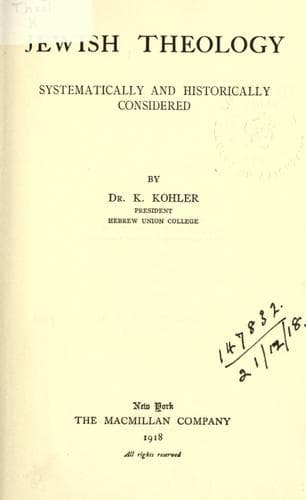
Jewish Theology, Systematically and Historically ConsideredKohler, Kaufmann
Religion
Jewish Theology, Systematically and Historically Considered
Kohler, Kaufmann
Judaism -- Doctrines
Amos, the prophet of stern justice, has not yet reached the idea of
averting the divine wrath by the return of the sinner.(776) Hosea, the
prophet of divine mercy and loving-kindness, in his deep compassion for
the unfaithful and backsliding people, became the preacher of repentance
as the condition for attaining the divine pardon.
“Return, O Israel, unto the Lord thy God;
For thou hast stumbled in thine iniquity.
Take with you words (of repentance),
And return unto the Lord;
Say unto Him, “Forgive all iniquity,
And accept that which is good;
So will we render for bullocks the offering of our lips.’ ”(777)
The appeal of Jeremiah is still more vigorous:
“Return, thou backsliding Israel, saith the Lord....
Only acknowledge thine iniquity, that thou hast transgressed
against the Lord thy God....
Break up for you a fallow ground, and sow not among thorns....
O Jerusalem, wash thy heart from wickedness, that thou mayest be
saved;
How long shall thy baleful thoughts lodge within thee?...
Return ye now every one from his evil way, and amend your ways and
your doings.”(778)
Ezekiel, while emphasizing the guilt of the individual, preached
repentance still more insistently. “Return ye, and turn yourselves from
all your transgressions; so shall they not be a stumbling-block of
iniquity to you. Cast away from you all your transgressions, wherein ye
have transgressed; and make you a new heart and a new spirit; for why will
ye die, O house of Israel? For I have no pleasure in the death of him that
dieth, saith the Lord God; wherefore turn yourselves, and live.”(779) The
same appeal recurs after the exile in the last prophets, Zechariah(780)
and Malachi.(781) The latter says: “Return unto Me, and I shall return
unto you.” Likewise the penitential sermon written in a time of great
distress, which is ascribed to the prophet Joel, contains the appeal:
“Turn ye unto Me with all your heart,
And with fasting, and with weeping, and with lamentation;
And rend your heart, and not your garments,
And turn unto the Lord your God;
For He is gracious and compassionate,
Long-suffering, and abundant in mercy,
And repenteth Him of the evil.”(782)
This prophetic view, which demands contrition and craving for God instead
of external modes of atonement, is expressed in the penitential Psalms as
well,(783) especially in Psalm LI. The idea is expanded further in the
parable of the prophet Jonah, which conveys the lesson that even a heathen
nation like the people of Nineveh can avert the impending judgment of God
by true repentance.(784) From this point of view the whole conception took
on a larger aspect, and the entire history of mankind was seen in a new
light. The Jewish sages realized that God punishes man only when the
expected change of mind and heart fails to come.(785)
Public-domain text, read in full here on John Shaqi.
Reviews
Reviews
No reviews yet
Be the first to share your thoughts on this work.
Elsewhere in the archive
Join the Discussion
Join the discussion
Sign in to leave a comment or review.
Sign InorCreate an account