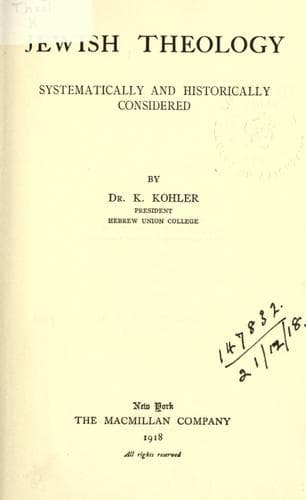
Jewish Theology, Systematically and Historically ConsideredKohler, Kaufmann
Religion
Jewish Theology, Systematically and Historically Considered
Kohler, Kaufmann
Judaism -- Doctrines
5. The Jewish plan of divine salvation presents a striking contrast to
that of the Church, for it is built upon the presumption that all sinners
can find their way back to God and godliness, if they but earnestly so
desire. Even before God created the world, He determined to offer man the
possibility of _Teshubah_, so that, in the midst of the continual struggle
with the allurements of the senses, the repentant sinner can ever change
heart and mind and return to God.(786) Without such a possibility the
world of man could not endure; thus, because no man can stand before the
divine tribunal of stern justice, the paternal arm of a merciful God is
extended to receive the penitent. This sublime truth is constantly
reiterated in the Talmud and in the liturgy, especially of the great Day
of Atonement.(787) Not only does God’s long-suffering give the sinner time
to repent; His paternal love urges him to return. Thus the Haggadists
purposely represent almost all the sinners mentioned in the Bible as
models of sincere repentance. First of all comes King David, who is
considered such a pattern of repentance, as the author of the fifty-first
Psalm, that he would not have been allowed to sin so grievously, if he had
not been providentially appointed as the shining example of the penitent’s
return to God.(788) Then there is King Manasseh, the most wicked among all
the kings of Judah and Israel, who had committed the most abominable sins
of idolatrous worship. Referring to the story told of him in Chronicles,
it is said that God responded to his tearful prayers and incessant
supplications by opening a rift under His throne of mercy and receiving
his petition for pardon. Thus all mankind might see that none can be so
wicked that he will not find the door of repentance open, if he but seek
it sincerely and persistently.(789) Likewise Adam and Cain, Reuben and
Judah, Korah, Jeroboam, Ahab, Josiah, and Jechoniah are described in
Talmud, Midrash, and the apocalyptic literature as penitent sinners who
obtained at last the coveted pardon.(790) The optimistic spirit of Judaism
cannot tolerate the idea that mortal man is hopelessly lost under the
burden of his sins, or that he need ever lose faith in himself. No one can
sink so low that he cannot find his way back to his heavenly Father by
untiring self-discipline. As the Talmud says, nothing can finally
withstand the power of sincere repentance: “It reaches up to the very seat
of God;” “upon it rests the welfare of the world.”(791)
Public-domain text, read in full here on John Shaqi.
Reviews
Reviews
No reviews yet
Be the first to share your thoughts on this work.
Elsewhere in the archive
Join the Discussion
Join the discussion
Sign in to leave a comment or review.
Sign InorCreate an account