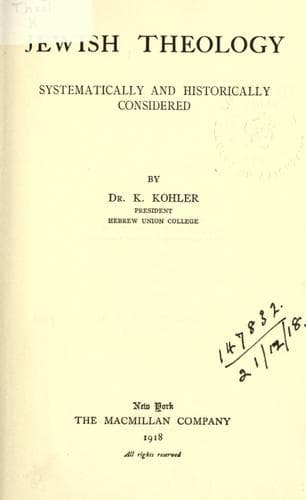
Jewish Theology, Systematically and Historically ConsideredKohler, Kaufmann
Religion
Jewish Theology, Systematically and Historically Considered
Kohler, Kaufmann
Judaism -- Doctrines
However, the long-cherished hope for a universal conversion of the heathen
world, voiced in the preachments and the prayers of the “pious ones,” gave
way to a reaction. The rise of antinomian sects in Judaism occasioned the
dropping of this pious hope, and only certain individual conversions were
dwelt on as shining exceptions.(797) The heathen world in general was not
regarded as disposed to repent, and so its ultimate fate was the doom of
Gehenna. Experience seemed to confirm the stern view, which rabbinical
interpretation could find in Scripture also, that “Even at the very gate
of the nether world wicked men shall not return.”(798) The growing
violence of the oppressors and the increasing number of the maligners of
Judaism darkened the hope for a universal conversion of humanity to the
pure faith of Israel and its law of righteousness. On the contrary, a
certain satisfaction was felt by the Jew in the thought that these enemies
of Judaism should not be allowed to repent and obtain salvation in the
hereafter.(799)
8. The idea of repentance was applied all the more intensely in Jewish
life, and a still more prominent place was accorded it in Jewish
literature. The rabbis have numberless sayings(800) in the Talmud and also
in the Haggadic and ethical writings concerning the power and value of
repentance. In passages such as these we see how profoundly Judaism dealt
with the failings and shortcomings of man. The term _asa teshubah_, do
repentance, implies no mere external act of penitence, as Christian
theologians often assert. On the contrary, the chief stress is always laid
on the feeling of remorse and on the change of heart which contrition and
self-accusation bring. Yet even these would not be sufficient to cast off
the oppressive consciousness of guilt, unless the contrite heart were
reassured by God that He forgives the penitent son of man with paternal
grace and love. In other words, religion demands a special means of
atonement, that is, _at-one-ment_ with God, to restore the broken relation
of man to his Maker. The true spiritual power of Judaism appears in this,
that it gradually liberates the kernel of the atonement idea from its
priestly shell. The Jew realizes, as does the adherent of no other
religion, that even in sin he is a child of God and certain of His
paternal love. This is brought home especially on the Day of Atonement,
which will be treated in a later chapter.
Public-domain text, read in full here on John Shaqi.
Reviews
Reviews
No reviews yet
Be the first to share your thoughts on this work.
Elsewhere in the archive
Join the Discussion
Join the discussion
Sign in to leave a comment or review.
Sign InorCreate an account