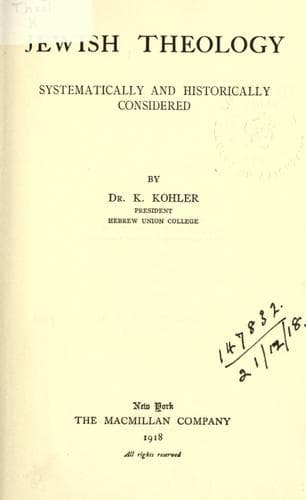
Jewish Theology, Systematically and Historically ConsideredKohler, Kaufmann
Religion
Jewish Theology, Systematically and Historically Considered
Kohler, Kaufmann
Judaism -- Doctrines
6. The rabbis follow up the idea first announced in the book of Jonah,
that the saving power of repentance applies to the heathen world as well.
Thus they show how God constantly offered time and opportunity to the
heathens for repentance. For example, when the generation of the flood,
the builders of the Tower of Babel, and the people of Sodom and Gomorrah
were to be punished, God waited to give them time for Repentance and
improvement of their ways.(792) Noah, Enoch, and Abraham are represented
as monitors of their contemporaries, warning them, like the prophets, to
repent in time lest they meet their doom.(793) Thus the whole Hellenistic
literature of propaganda, especially the Sibylline books, echoes the
warning and the hope that the heathen should repent of their grievous sins
and return to God, whom they had deserted in idolatry, so that they might
escape the impending doom of the last judgment day. According to one
Haggadist,(794) even the Messiah will appear first as a preacher of
repentance, admonishing the heathen nations to be converted to the true
God and repent before Him, lest they fall into perdition. Indeed, it is
said that even Pharaoh and the Egyptians were warned and given time for
repentance before their fate overtook them.
7. Accordingly, the principle of repentance is a universal human one, and
by no means exclusively national, as the Christian theologians represent
it.(795) The sages thus describe Adam as the type of the penitent sinner,
who is granted pardon by God. The “sign” of Cain also was to be a sign for
all sinners, assuring them they might all obtain forgiveness and
salvation, if they would but return to God.(796) In fact, the prophetic
appeal to Israel for repentance, vain at the time, effected the
regeneration of the people during the Exile and gave rise to Judaism and
its institutions. In the same way, the appeal to the heathen world by the
Hellenistic propaganda and the Essene preachers of repentance did not
induce the nations at once to prepare for the coming of the Messianic
kingdom, but finally led to the rise of the Christian religion, and,
through certain intermediaries, of the Mohammedan as well.
Public-domain text, read in full here on John Shaqi.
Reviews
Reviews
No reviews yet
Be the first to share your thoughts on this work.
Elsewhere in the archive
Join the Discussion
Join the discussion
Sign in to leave a comment or review.
Sign InorCreate an account