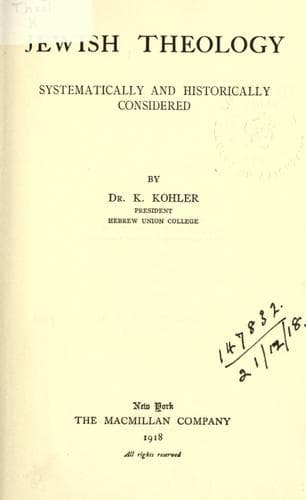
Jewish Theology, Systematically and Historically ConsideredKohler, Kaufmann
Religion
Jewish Theology, Systematically and Historically Considered
Kohler, Kaufmann
Judaism -- Doctrines
4. In the Hellenistic literature, with its dominating idea of universal
monotheism, God is frequently invoked or spoken of as the Father of
mankind. The implication is that each person who invokes God as Father
enters into filial relation with Him. Thus what was first applied to
Israel in particular was now broadened to include mankind in general, and
consequently all men were considered “children of the living God.” The
words of God to Pharaoh, speaking of Israel as His “first-born son,”(824)
were taken as proof that all the nations of the earth are sons of God and
He the universal Father. Israel is the first-born among the sons of God,
because his patriarchs, prophets, and psalmists first recognized Him as
the universal Father and Ruler. From this point of view Judaism declared
love for fellow-men and regard for the dignity of humanity to be
fundamental principles of ethics. “As God is kind and merciful toward His
creation, be thou also kind and merciful toward all fellow-creatures,” is
the oft-repeated teaching of the rabbis.(825) Likewise, “Whoever takes
pity on his fellow-beings, on him God in heaven will also take pity.”(826)
Love of humanity has so permeated the nature of the Jew that the rabbis
assert: “He who has pity on his fellow-men has the blood of Abraham in his
veins.”(827) This bold remark casts light upon the strange dictum: “Ye
Israelites are called by the name of man, but the heathen are not.”(828)
The Jewish teachers were so deeply impressed with man’s inhumanity to man,
so common among the heathen nations, and the immorality of the lives by
which these desecrated God’s image, that they insisted that the laws of
humanity alone make for divine dignity in man.
5. Rabbi Akiba probably referred to the Paulinian dogma that Jesus, the
crucified Messiah, is the only son of God, in his well-known saying:
“Beloved is man, for he is created in God’s image, and it was a special
token of love that he became conscious of it. Beloved is Israel, for they
are called the children of God, and it was a special token of love that
they became conscious of it.”(829) Here he claims the glory of being a son
of God for Israel, but not for all men. Still, as soon as the likeness of
man to God is taken in a spiritual sense, then it is implied that all men
have the same capacity for being a son of God which is claimed for Israel.
This is unquestionably the view of Judaism when it considers the Torah as
entrusted to Israel to bring light and blessing to all the families of
men. Rabbi Meir, the disciple of Rabbi Akiba, said: “The Scriptural words,
‘The statutes and ordinances which _man_ shall do and live thereby,’ and
similar expressions indicate that the final aim of Judaism is not attained
by the Aaronide, nor the Levite, nor even the Israelite, but by
mankind.”(830) Such a saying expresses clearly and emphatically that God’s
fatherly love extends to all men as His children.
Public-domain text, read in full here on John Shaqi.
Reviews
Reviews
No reviews yet
Be the first to share your thoughts on this work.
Elsewhere in the archive
Join the Discussion
Join the discussion
Sign in to leave a comment or review.
Sign InorCreate an account