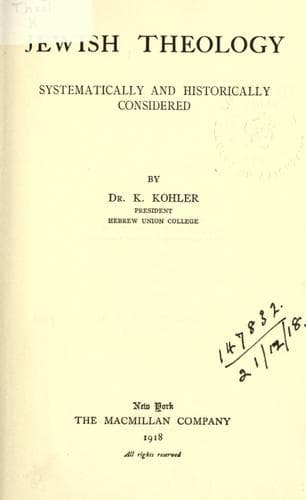
Jewish Theology, Systematically and Historically ConsideredKohler, Kaufmann
Religion
Jewish Theology, Systematically and Historically Considered
Kohler, Kaufmann
Judaism -- Doctrines
6. According to the religious consciousness of modern Israel man is made
in God’s image, and is thus a child of God. Consequently Jew and non-Jew,
saint and sinner have the same claim upon God’s paternal love and mercy.
There is no distinction in favor of Israel except as he lives a higher and
more god-like life. Even those who have fallen away from God and have
committed crime and sin remain God’s children. If they send up their
penitent cry to the throne of God, “Pardon us, O Father, for we have
sinned! Forgive us, O King, for we have done evil!”; their prayer is heard
by the heavenly Father exactly like that of the pious son of Israel.
Chapter XLI. Prayer and Sacrifice
1. The gap between man and the sublime Master of the universe is vast, but
not absolute. The thoughts of God are high above our thoughts, and the
ways of God above our ways, baffling our reason when we endeavor to solve
the vexatious problems of destiny, of merit and demerit, of retribution
and atonement. Yet religion offers a wondrous medium to bring the heart of
man into close communion with Him who is enthroned above the heavens, one
that overleaps all distances, removes all barriers, and blends all
dissonances into one great harmony, and that is—Prayer. As the child must
relieve itself of its troubles and sorrows upon the bosom of its mother or
father in order to turn its pain into gladness, so men at all times seek
to approach the Deity, confiding to Him all their fears and longings in
order to obtain peace of heart. Prayer, communion between the human soul
and the Creator, is the glorious privilege enjoyed by man alone among all
creatures, as he alone is the child of God. It voices the longing of the
human heart for its Father in heaven. As the Psalmist has it, “My soul
thirsteth for God, for the living God.”(831)
2. However, both language, the means of intercourse between man and man,
and prayer, the means of intercourse between man and God, show traces of a
slow development lasting for thousands of years, until the loftiest
thoughts and sublimest emotions could be expressed. The real efficacy of
prayer could not be truly appreciated, until the prophetic spirit
triumphed over the priestly element in Judaism. In the history of speech
the language of signs preceded that of sounds, and images gradually
ripened into abstract thoughts. Similarly, primitive man approaches his
God with many kinds of gifts and sacrificial rites to express his
sentiments. He acts out or depicts what he expects from the Deity, whether
rain, fertility of the soil, or the extermination of his foes. He shares
with his God his food and drink, to obtain His friendship and protection
in time of trouble, and sacrifices the dearest of his possessions to
assuage His wrath or obtain His favor.
Public-domain text, read in full here on John Shaqi.
Reviews
Reviews
No reviews yet
Be the first to share your thoughts on this work.
Elsewhere in the archive
Join the Discussion
Join the discussion
Sign in to leave a comment or review.
Sign InorCreate an account