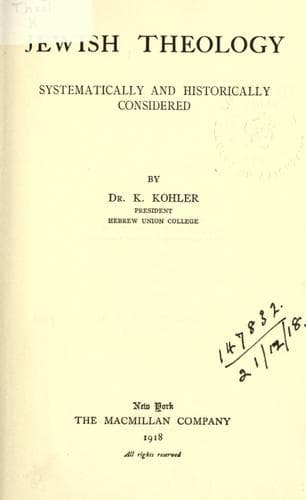
Jewish Theology, Systematically and Historically ConsideredKohler, Kaufmann
Religion
Jewish Theology, Systematically and Historically Considered
Kohler, Kaufmann
Judaism -- Doctrines
3. In the lowest stage of culture man needed no mediator in his
intercourse with the Deity, who appeared to him in the phenomena of nature
as well as in the fetish, totem, and the like. But soon he rose to a
higher stage of thought, and the Deity withdrew before him to the
celestial heights, filling him with awe and fear; then rose a class of men
who claimed the privilege to approach the Deity and influence Him by
certain secret practices. Henceforth these acted as mediators between the
mass of the people and the Deity. In the first place, these were the
magicians, medicine-men, and similar persons, who were credited with the
power to conjure up the hidden forces of nature, considered either divine
or demoniac. After these arose the priests, distinguished from the people
by special dress and diet, who established in the various tribes temples,
altars, and cults, under their own control. Then there were the saints,
pious penitents or Nazarites, who led an ascetic life secluded from the
masses, hoping thus to obtain higher powers over the will of the Deity.
All these entertained more or less clearly the notion that they stood in
closer relation to the Deity than the common people, whom they then
excluded from the sanctuary and all access to the Deity.
The Mosaic cult, in the so-called Priestly Code, was founded upon this
stage of religious life, forming a hierarchical institution like those of
other ancient nations. It differed from them, however, in one essential
point. The prime element in the cult of other nations was magic,
consisting of oracle, incantation and divination, but this was entirely
contrary to the principles of the Jewish faith. On the other hand, all the
rites and ceremonies handed down from remote antiquity were placed in the
service of Israel’s holy God, in order to train His people into the
highest moral purity. The patriarchs and prophets, who are depicted in
Scripture as approaching God in prayer and hearing His voice in reply,
come under the category of saints or elect ones, above the mass of the
people.
Public-domain text, read in full here on John Shaqi.
Reviews
Reviews
No reviews yet
Be the first to share your thoughts on this work.
Elsewhere in the archive
Join the Discussion
Join the discussion
Sign in to leave a comment or review.
Sign InorCreate an account