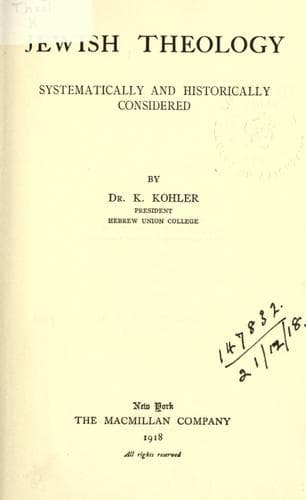
Jewish Theology, Systematically and Historically ConsideredKohler, Kaufmann
Religion
Jewish Theology, Systematically and Historically Considered
Kohler, Kaufmann
Judaism -- Doctrines
Nevertheless, the deeper religious consciousness of the people felt that
the celestial gate of divine mercy opens only to prayer, which emanates
from the innermost depths of the soul. Accordingly, some of the Haggadists
try to prove from Scripture that prayer ranks above sacrifice,(847) while
others even identify worship with prayer.(848) They represent God as
appearing to Moses in the guise of one who leads the congregation in
prayer, His face covered by the prayer-shawl (_tallith_), in order to
teach man for all time the mode and power of prayer.(849) Still these
remain isolated expressions of an underlying sentiment; on the whole, the
rabbis regarded the Mosaic legislation, with its emphasis on sacrifice,
far too highly to accord prayer any but a secondary place, either
accompanying sacrifice or as its substitute.(850)
9. Through many centuries, then, the belief in the divine origin of the
sacrificial cult remained, even though it could no longer be carried out.
The liturgy contained prayers for the speedy restoration of the Temple and
the sacrifices, which were preserved by tradition, and nowhere was even an
echo heard of the bold words of Jeremiah denying the divine character of
the sacrifices,(851) even though the idea of the restoration of the old
cult must have been repugnant to thinkers. The sages of former ages could
only resort to a compromise or an allegorical interpretation. It is
noteworthy that the Haggadist Rabbi Levi considered the sacrifices a
concession of God to the people, who were disposed to idolatry, in order
to win them gradually for the pure monotheistic ideal.(852) This view was
adopted by the Church Fathers, and later by Maimonides and other medieval
thinkers. On the other hand, an allegorical meaning was assigned to the
sacrifices by Philo and Jehuda ha Levi, as well as by Samson Raphael
Hirsch in modern times.(853)
Public-domain text, read in full here on John Shaqi.
Reviews
Reviews
No reviews yet
Be the first to share your thoughts on this work.
Elsewhere in the archive
Join the Discussion
Join the discussion
Sign in to leave a comment or review.
Sign InorCreate an account