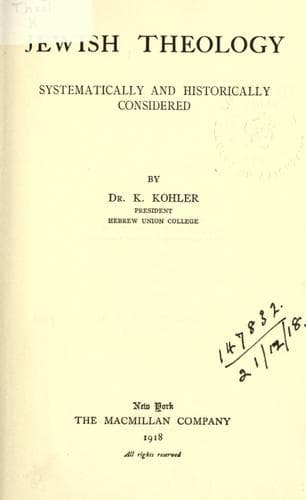
Jewish Theology, Systematically and Historically ConsideredKohler, Kaufmann
Religion
Jewish Theology, Systematically and Historically Considered
Kohler, Kaufmann
Judaism -- Doctrines
Reform Judaism, recognizing the results of Biblical research and the law
of religious progress, adopted the prophetic view of the sacrifices.
Accordingly, the sacrificial cult of the Mosaic code has no validity for
the liberal movement, and all reference to it has been eliminated from the
reform liturgy. In this, however, the connection with the past was by no
means severed. The main part of the service remains the same, although
much of the character and many of the details have been changed.(854) Only
the allusions to the Temple worship and the sacrifices were eliminated,
and the entire form of the service was made more solemn and inspiring “by
combining ancient time-honored formulas with modern prayers and
meditations in the vernacular and in the spirit of the age.” The morning
and evening services retained their places, while the additional festal
service (_mussaf_) was abrogated, because it stood for the additional
festal sacrifice. As to the voluntary element in the old sacrificial
system, the peace, sin, and thank-offerings, this is replaced in the
reform ritual, as in the traditional practice, by private devotions for
special occasions, to be selected by the individual.
The traditional Jewish prayer has certainly a wondrous force. It remains a
source of inspiration from which the religious consciousness will ever
draw new strength and vitality. It echoes the voice of Israel singing the
song of redemption by the Red Sea: “This is My God, and I will glorify
Him; My father’s God, and I will exalt Him.”(855) Consequently our liturgy
must ever respond to a double demand; it must throb with the spirit of
continuity with our great past, to make us feel one with our fathers of
yore; and it must express clearly and fully our own views and needs, our
convictions and our hopes.
Chapter XLII. The Nature and Purpose of Prayer
1. Prayer is the expression of man’s longing and yearning for God in times
of dire need and of overflowing joy, an outflow of the emotions of the
soul in its dependence on God, the ever-present Helper, the eternal Source
of its existence. Springing from the deepest necessity of human weakness,
the expression of a momentary wish, prayer is felt to be the proud
prerogative of man as the child of God, and at last it becomes adoration
of the Most High, whose wisdom and whose paternal love and goodness
inspire man with confidence and love.
Public-domain text, read in full here on John Shaqi.
Reviews
Reviews
No reviews yet
Be the first to share your thoughts on this work.
Elsewhere in the archive
Join the Discussion
Join the discussion
Sign in to leave a comment or review.
Sign InorCreate an account