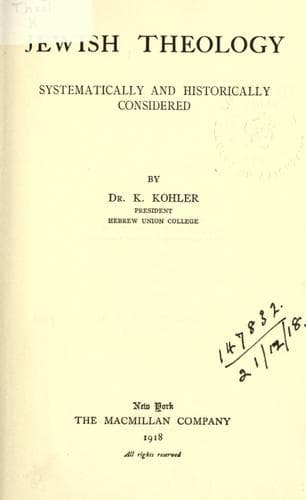
Jewish Theology, Systematically and Historically ConsideredKohler, Kaufmann
Religion
Jewish Theology, Systematically and Historically Considered
Kohler, Kaufmann
Judaism -- Doctrines
9. Therefore prayer offered with the community upon the sanctified ground
of the house of God exerts a specially powerful influence upon the
individual. In the silent chamber the oppressed spirit may find calm and
composure in prayer; but the pure atmosphere of heavenly freedom and bliss
is attained with overwhelming might only by the united worship of hundreds
of devout adorers, which rings out like the roaring of majestic billows:
“The Lord is in His holy temple; let all the earth keep silence before
Him.”(876) The familiar strains from days of yore touch the deep,
long-silent chords of the heart, and awaken dormant sentiments and
repressed thoughts, endowing the soul with new wings, to lift itself up
toward God, the Father, from whom it had felt itself alienated. In the
ardor of communal worship the traditional words of the prayer-book obtain
invigorating power; the heart is newly strengthened; the covenant with
heaven sealed anew. To such communal prayer, which springs from the heart,
the rabbis refer the Biblical words, “to serve Him with the whole
heart.”(877) The synagogal worship exerts an ennobling influence upon the
spirit of the individual as well as that of the community. For after all
the main object is that the soul which aspires toward God may learn to
find God. “Seek ye the Lord while He may be found; call ye upon Him while
He is near.”(878) No man is so poor as he who calls in agony: “O God!” and
to whom neither the heaven above nor the heart within answers, “Behold,
God is here.” Nor is any man so rich with all his possessions as he who
realizes, like the Psalmist, that “the nearness of God is the true good,”
and imbued with this thought exclaims, “Whom have I in heaven but Thee?
And beside Thee I desire none upon earth.”(879)
Chapter XLIII. Death and the Future Life
1. The vision of man is directed upwards and forwards; he will not resign
himself to decay in the dust like the beast. As he bears in his breast the
consciousness of a higher divine world, he is equally confident of his own
continuity after death. He cannot and will not believe that with the
giving up of his last living breath his being would become dust like that
of the animal; or that his soul, which has hitherto accomplished and
planned so much, should now suddenly cease altogether to exist. The
longing for a future life, however expressed, has filled him and buoyed
him up since the very beginning of history. Even the most primitive tribe
does not allow its dead to lie and rot like the carcasses of the beast,
but lays them to rest in the grave with all their possessions, in the
expectation that somewhere and somehow, under, over or beyond the earth,
they will continue their lives, even in a better form than before.
Public-domain text, read in full here on John Shaqi.
Reviews
Reviews
No reviews yet
Be the first to share your thoughts on this work.
Elsewhere in the archive
Join the Discussion
Join the discussion
Sign in to leave a comment or review.
Sign InorCreate an account