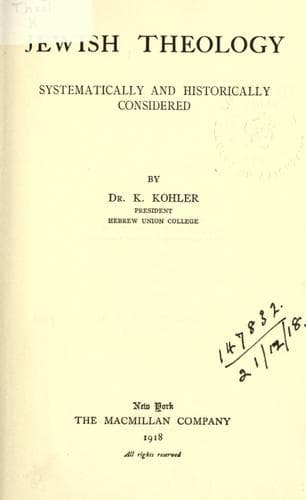
Jewish Theology, Systematically and Historically ConsideredKohler, Kaufmann
Religion
Jewish Theology, Systematically and Historically Considered
Kohler, Kaufmann
Judaism -- Doctrines
This longing for immortality implanted in the human soul is so represented
in the legend of Paradise that the tree whose fruit bestowed upon the
celestial beings the gift of eternal life—like the Greek ambrosia, “the
food of the gods”—was originally intended for mankind also in the divine
“Garden of Bliss.” But after man fell through sin, all access to it was
denied him, in order that he might not stretch out his hand for it and
thereby attain that immortality which was vouchsafed only to divine
beings.(880) According to his original destiny, therefore, man should live
forever; and, just as legend allows those divinely elected, like Enoch and
Elijah,(881) to ascend to heaven alive, so at a later period prophecy
predicts a time when God will annihilate death forever.(882) Accordingly,
through the power of his divine soul man possesses a claim to immortality,
to eternal life with God, the “Fountain of life.”
2. It was just this keen longing for an energetic life on earth, this
mighty yearning to “walk before God in the land of the living,”(883) which
made it more difficult for Judaism to brighten the “valley of the shadow
of death” and to elevate the vague notion of a shadowy existence in the
hereafter into a special religious teaching. Until long after the Exile
the Jewish people shared the view of the entire ancient world,—both the
Semitic nations, such as the Babylonians and Phœnicians, and the Aryans,
such as the Greeks and Romans,—that the dead continue to exist in the
shadowy realm of the nether world (_Sheol_), the land of no return
(_Beliyaal_),(884) of eternal silence (_Dumah_), and oblivion
(_Neshiyah_),(885) a dull, ghostly existence without clear consciousness
and without any awakening to a better life. We must, however, not overlook
the fact that even in these most primitive conceptions a certain
imperishability is ascribed to man as marking his superiority over the
animal world, which is altogether abandoned to decay. Hence the belief in
the existence of the shades, the _Refaim_ in Sheol.(886) But throughout
the Biblical period no ethical idea yet permeated this conception, and no
attempt was made to transform the nether world into a place of divine
judgment, of recompense for the good and evil deeds accomplished on
earth,(887) as did the Babylonians and Egyptians. Both the prophets and
the Mosaic code persist in applying their promises and threats, in fact,
their entire view of retribution, to this world, nor do they indicate by a
single word the belief in a judgment or a weighing of actions in the world
to come.
Public-domain text, read in full here on John Shaqi.
Reviews
Reviews
No reviews yet
Be the first to share your thoughts on this work.
Elsewhere in the archive
Join the Discussion
Join the discussion
Sign in to leave a comment or review.
Sign InorCreate an account