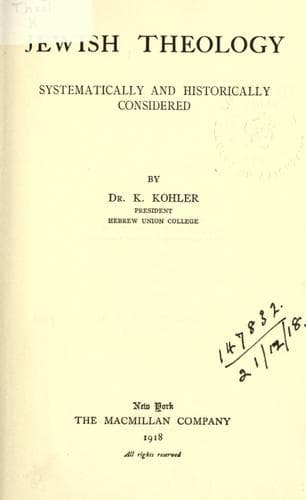
Jewish Theology, Systematically and Historically ConsideredKohler, Kaufmann
Religion
Jewish Theology, Systematically and Historically Considered
Kohler, Kaufmann
Judaism -- Doctrines
The conception that the soul enters into man as the breath of life and
leaves him at his death, flying toward heaven like a bird,(913) is quite
as ancient and as universal as the other, that the soul descends into the
nether world as a shadowy image of the body, there to continue a dull
existence. The two are related to one another, and in the Bible, as well
as in the literature of other peoples, they have given rise to diverse
definitions of the soul. This was the point of departure for the
development of the conception of immortality in one or the other
direction, according to whether the body was considered a part of the
personality which somehow survives after death, or only the spiritual
substance of the soul was thought to live on in celestial regions as
something divine. The former led to the theory of the resurrection of the
body and its reunion with the soul; the latter to the belief in a future
life for the soul, after it had been separated or released from the body.
3. When once the soul was felt to be a “lamp of the Lord,” filling the
body with light when man is awake,(914) it was easy to imagine that the
soul had escaped and temporarily returned to God in sleep. This induced
the teachers of the Synagogue to prescribe a morning prayer of thanks
which reads, “Blessed art Thou, O God, who restorest the souls unto dead
bodies.”(915) The conception underlying this prayer throws light upon the
entire belief in resurrection. Death to the pious is only a prolonged
sleep. On that account the prophet in the passage from Isaiah already
referred to, as well as the Hasidic author of the Book of Daniel,(916)
could express the hope that “those who sleep in the dust shall awake.” As
at every awakening from sleep in the morning, so at the great awakening in
the future, the souls which have departed in death shall return again to
their bodies. These bodies could then hardly be conceived of as subject to
decomposition, and the picture in Ezekiel’s vision of resurrection(917)
had to be accepted as fact. Still R. Simeon b. Yohai in the especially
instructive thirty-fourth chapter of Pirke de R. Eliezer assumes the
complete disintegration of the body, in order to render the miracle of
resurrection so much the greater. Later still arose the legend of an
indestructible bone of the spinal column, called _Luz_, which was to form
the nucleus for the revival of the whole body.(918) The name Luz, which
denotes an almond tree and is the name given in the Bible to a city
also,(919) seemed to point to a connection with two legends, a fabulous
city into which death could not enter,(920) and the tree of resurrection
in the Osiris cycle.(921)
Public-domain text, read in full here on John Shaqi.
Reviews
Reviews
No reviews yet
Be the first to share your thoughts on this work.
Elsewhere in the archive
Join the Discussion
Join the discussion
Sign in to leave a comment or review.
Sign InorCreate an account