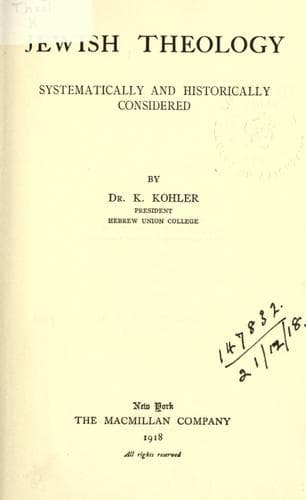
Jewish Theology, Systematically and Historically ConsideredKohler, Kaufmann
Religion
Jewish Theology, Systematically and Historically Considered
Kohler, Kaufmann
Judaism -- Doctrines
4. Still, no clear, consistent view of the soul prevailed as yet in the
rabbinic age. The popular belief, influenced by Persian notions, was that
the soul lingers near the body for a certain time after it has
relinquished it, either from three to seven days or for an entire
year.(922) Furthermore it was said that after death the souls hovered
between heaven and earth in the form of ghosts, able to overhear the
secrets of the future decreed above and to betray them to human beings
below. In fact, the rabbis of the Talmud, especially the Hasidim, never
hesitated to accept these ghost stories.(923) Some sages of the Talmudic
period taught that the souls of the righteous ascend to heaven, there to
dwell under the throne of the divine majesty, awaiting the time of the
renewal of the world, while the souls of the godless hovered over the
horizon of the earth as restless demoniacal spirits, finally to succumb to
the fate of annihilation, after they had been cast down into the fiery pit
of Gehenna or Sheol.(924) Of course, this view, which prevails in both the
Talmud and the New Testament, according to which the souls of the wicked
are to be consumed in the fire of Gehenna, is inconsistent with the
conception of the purely spiritual nature of the soul.
Nevertheless at this same epoch we find the higher idea expressed that the
soul is an invisible, god-like essence, pervading the body as a spiritual
force and differing from it in nature in much the same way as God is
differentiated from the world.(925) “Thou wishest to know where God
dwells, who is as high as are the heavens above the earth; tell me then
where dwells thy soul, which is so near,” replied R. Gamaliel to a
heathen.(926) The prevailing view of the schools is that God implants the
soul in the embryo while in the mother’s womb, together with all the
spiritual potentialities which make it human. In fact, R. Simlai, the
third-century Haggadist, advances the Platonic conception of the
preëxistence of the soul, as a being of the highest intelligence, which
sees before birth all things throughout the world, but forgets all at
birth, so that all subsequent learning is only a recollection.(927) In
Hellenistic Judaism especially the doctrine seems to have been general of
the preëxistence of the soul, or of the creation of all human souls
simultaneously with the creation of the world.(928) Of course, the soul
which emanates from a higher world must be eternal.
Public-domain text, read in full here on John Shaqi.
Reviews
Reviews
No reviews yet
Be the first to share your thoughts on this work.
Elsewhere in the archive
Join the Discussion
Join the discussion
Sign in to leave a comment or review.
Sign InorCreate an account