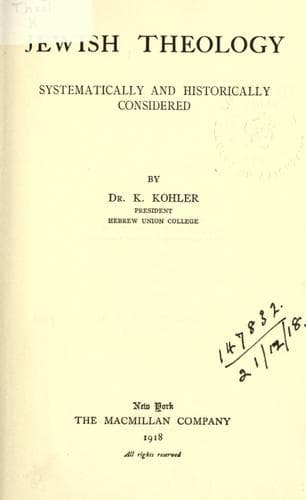
Jewish Theology, Systematically and Historically ConsideredKohler, Kaufmann
Religion
Jewish Theology, Systematically and Historically Considered
Kohler, Kaufmann
Judaism -- Doctrines
5. The first clear idea of the nature of the soul came with the
philosophically trained thinkers, who were dependent either on Plato, main
founder of the doctrine of the immortality of the soul, or on Aristotle,
who ascribes immortality only to the creative spirit of God, the supreme
Intelligence as a cosmic power. The nearest approach to Plato was
Philo,(929) who saw in the three Biblical names for the soul, _nefesh_,
_ruah_, and _neshama_, the three souls of the Platonic system,—the
sensuous soul, which has its seat in the abdomen; the courageous or
emotional soul, situated in the breast; and the intellectual soul, which
dwells in the brain and contains the imperishable divine nature. This last
is kept in its physical environment as in a prison or a grave, and ever
yearns for liberation and reunion with God. The soul of the righteous
enters the world of angels after death; that of the wicked the world of
demons.
Saadia, who was under the influence of Aristotle interpreted from the
neo-Platonic viewpoint, did not share the Platonic dualism of matter and
spirit, nor did he divide the soul into three parts, seated in various
parts of the human body. He finds the soul to be a spiritual substance
created simultaneously with the body, and uniting the three forces of the
soul distinguished in Scripture into one inseparable whole, the seat of
which is in the heart,—wherefore soul and heart are often synonymous in
the Bible. This indivisible substance possesses a luminous nature like
that of the spheres, but is simpler, finer, and purer than they, and
endowed with the power of thought. It was created by God out of the primal
ether from which He made the angels, simultaneously with the body and
within it. By this union it was qualified to display that moral activity
prescribed for it in the divine teaching, the neglect of which would
defile and tarnish it. According to Saadia some kind of material substance
adheres to the soul as well as to the angels, and on that account he does
not hesitate to accept the Talmudic expressions about the abode of the
soul after death, or the last judgment which is to take place as soon as
the appointed number of souls shall have made their entrance into their
earthly bodies, when the souls of the righteous will have their angelic
nature recognized, and those of the wicked will have their lower character
revealed. However, Saadia combats with so much greater fervor the Hindu
teaching of metempsychosis, which had been adopted by Plato and
Pythagoras.(930)
Bahya connects his theory with the three souls of Plato, and likewise
ascribes to the soul an ethereal essence.(931) He holds that its destiny
is to raise itself to the order of the angels through self-purification,
and finally to return to God as the divine Source of light. To this end
the intellectual soul, which has its being from the primal light, must
overcome the lower sensuous soul which leads to sin.
Public-domain text, read in full here on John Shaqi.
Reviews
Reviews
No reviews yet
Be the first to share your thoughts on this work.
Elsewhere in the archive
Join the Discussion
Join the discussion
Sign in to leave a comment or review.
Sign InorCreate an account