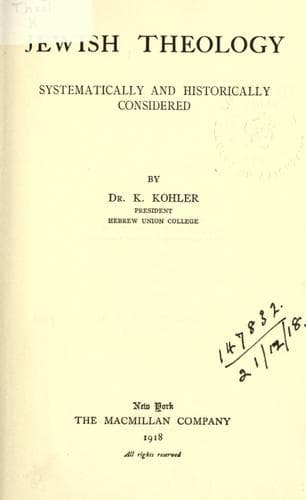
Jewish Theology, Systematically and Historically ConsideredKohler, Kaufmann
Religion
Jewish Theology, Systematically and Historically Considered
Kohler, Kaufmann
Judaism -- Doctrines
8. All these various thinkers find the future life either expressed or
suggested in the Scriptures as a truth based upon reason. This is
especially the conception of Abraham ibn Daud, who, contrary to his
Aristotelian successor Maimonides, sees in self-consciousness, by which
the soul differentiates itself from the body as a personality, the proof
that it cannot be subject to dissolution with the body.(935)
Besides the philosophic doctrine of the immortality of the soul, however,
the traditional belief in the resurrection of the body demanded some
consideration on the part of these philosophers. Saadia defends the latter
with all his might, endeavoring to reconcile the two as best he can.(936)
All the rest leave us in doubt whether resurrection is to be understood
literally or symbolically. Maimonides especially involves himself in
difficulties, inasmuch as in his commentary on the Mishna he considers the
resurrection of the dead an unalterable article of faith, whereas in his
Code(937) and in the Moreh he speaks only of immortality; and again before
the end of his life he wrote, obviously in self-defense, a work which
seems to favor bodily resurrection, yet without clarifying his conceptions
at any time.(938) The belief in resurrection had taken too deep a root in
the Jewish consciousness and had been too firmly established through the
liturgy of the Synagogue for any philosopher to touch it without injuring
the very foundations of faith.
Moreover, beside external caution a certain inner need seems to have
impelled toward the acceptance of resurrection. As soon as one thinks of
the soul as existing or continuing to live in an incorporeal state, one is
involuntarily led toward the belief in the soul’s preëxistence or even in
the possibility of metempsychosis. Thus it seemed more reasonable to
believe in a new formation of the human body together with a new creation
of the world. Therewith came the disposition to assign to the soul in the
future world a body of finer substance, like that assumed by the mystic
Nahmanides,(939) in order to assure to the new humanity a wondrous
duration of life like that of Elijah.
Public-domain text, read in full here on John Shaqi.
Reviews
Reviews
No reviews yet
Be the first to share your thoughts on this work.
Elsewhere in the archive
Join the Discussion
Join the discussion
Sign in to leave a comment or review.
Sign InorCreate an account