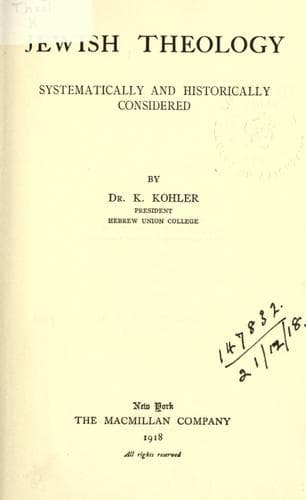
Jewish Theology, Systematically and Historically ConsideredKohler, Kaufmann
Religion
Jewish Theology, Systematically and Historically Considered
Kohler, Kaufmann
Judaism -- Doctrines
9. While the popular philosopher Albo rightly declares that the nature of
the soul is as far beyond all human understanding as is the nature of
God,(940) the mystics sought all the more to penetrate its secrets. The
Cabbalah also divides the soul into three different substances according
to the three Biblical names, assigning their origins to the three
different spheres of the universe, and reiterating the Platonic theory of
the preexistence of the soul and its future transmigration. This division
into three parts provided scope for all types of theories concerning the
soul in its sensuous, its moral, and its intellectual nature.
Fundamentally the Cabbalah considered the soul an emanation from the
divine intellect with a luminous character just like the philosophers. But
in the Platonic view of the ascending order of creation, which forms the
basis of the Cabbalah, this mundane life is an abyss of moral degradation,
so that the soul yearns toward the primal Source of light, finally to find
freedom and bliss with God.(941) Thus the later Cabbalah returned to the
teachings of Philo, the Jewish Plato, for whom death was only the
stripping off of the earthly frame in order to enter the pure and luminous
world of God.
10. With Moses Mendelssohn, who in his _Phædon_ tried to translate Plato’s
proof of immortality into modern terms, a new attitude toward the nature
and destiny of the soul arose in Judaism among both the philosophers and
the educated laity. Mendelssohn not only endeavored to prove the
immortality of the soul through its indivisibility and incorporeality, as
all the neo-Platonists and Jewish philosophers had done before him; he
also attempted to show from the harmonious plan which pervades and
controls all of God’s creation, that the soul may enter a sphere of
existence greater in extent and content than the little span of earthly
life which it relinquishes. The progress of the soul toward its highest
unfolding, unsatisfied in this life, demands a future growth in the
direction of god-like perfection.(942) At this point the philosopher
enters the province of faith, and thus furnishes for all time the cardinal
point of the belief in immortality. The divine spirit in man, which is
evinced in the self-conscious, morally active personality, bears within
itself the proof and promise of its future life. Moreover, this
corresponds with the belief in God as One who rules the world for the
eternal purposes and aims of perfection, who cannot deceive the hope of
the human heart for a continued living and striving onward and forward,
without thereby impairing His own perfection. For we all close our lives
without having attained the goal of moral and spiritual perfection toward
which we strive; and therefore our very nature demands a world where we
may reach the higher degree of perfection for which we long. In this sense
we may interpret the Psalmist’s verse: “I shall be satisfied, when I
Public-domain text, read in full here on John Shaqi.
Reviews
Reviews
No reviews yet
Be the first to share your thoughts on this work.
Elsewhere in the archive
Join the Discussion
Join the discussion
Sign in to leave a comment or review.
Sign InorCreate an account