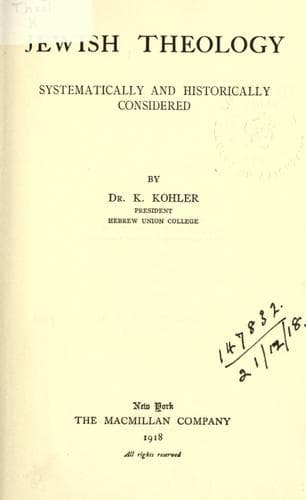
Jewish Theology, Systematically and Historically ConsideredKohler, Kaufmann
Religion
Jewish Theology, Systematically and Historically Considered
Kohler, Kaufmann
Judaism -- Doctrines
12. Certainly it is both comforting and convenient to imagine the dead who
are laid to rest in the earth as being asleep and to await their
reawakening. As the fructifying rain awakens to a new life the seeds
within the soil, so that they rise from the depths arrayed in new raiment,
so, when touched by the heavenly dew of life, will those who linger in the
grave arise to a new existence, clad in new bodies. This is the belief
which inspired the pious founders of the synagogal liturgy even before the
period of the Maccabees, when they expressed their praise of God’s power
in that He would send the fertilizing rain upon the vegetation of the
earth, and likewise in due time the revivifying dew upon the sleeping
world of man. Both appeared to the sages of that age to be evidences of
the same wonder-working power of God. Whoever, therefore, still sees God’s
greatness, as they did, revealed through miracles, that is, through
interruptions of the natural order of life, may cling to the traditional
belief in resurrection, so comforting in ancient times. On the other hand,
he who recognizes the unchangeable will of an all-wise, all-ruling God in
the immutable laws of nature must find it impossible to praise God
according to the traditional formula as the “Reviver of the dead,” but
will avail himself instead of the expression used in the Union Prayer Book
after the pattern of Einhorn, “He who has implanted within us immortal
life.”(945)
Chapter XLV. Divine Retribution: Reward and Punishment.
1. The feeling of equity is deeply rooted in human nature, demanding
reparation for every wanton wrong and yielding recognition to every
benevolent act. In fact, upon this universal principle is based all
justice and to a certain extent all morality. Judaism of every age
compresses this demand of the religious and moral nature of man into the
doctrine: God rewards the good and punishes the evil. This doctrine, which
is the eleventh of Maimonides’ articles of faith, constitutes the
underlying presumption of all the Biblical narratives as well as of the
prophetic threats and warnings and those of the Mosaic law, in so far as
earthly success and prosperity were regarded as the rewards of God and
earthly misfortune and misery as His punishments. In the same degree,
however, as experience contradicted this doctrine, and as examples
multiplied of wicked persons revelling in prosperity and innocent ones
laboring under adversity and woe, it became necessary to defer the divine
retribution more and more to the future—at first to a future on earth and
later to one in the world to come, until finally it developed into a pure
spiritual conception in full accord with a higher ethical view of life.
Public-domain text, read in full here on John Shaqi.
Reviews
Reviews
No reviews yet
Be the first to share your thoughts on this work.
Elsewhere in the archive
Join the Discussion
Join the discussion
Sign in to leave a comment or review.
Sign InorCreate an account