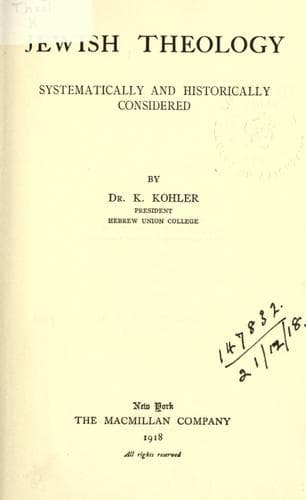
Jewish Theology, Systematically and Historically ConsideredKohler, Kaufmann
Religion
Jewish Theology, Systematically and Historically Considered
Kohler, Kaufmann
Judaism -- Doctrines
2. As long as in the primitive process of law the family or the clan was
held responsible for the crime of the individual, ancient Israel also
adhered to the idea that “God visits the sins of the fathers upon the
third and fourth generation,” as Jeremiah still did(946) in full accord
with the second commandment. It was in a far later stage that the rabbis
interpreted the words “of those who hate Me” in the sense of individual
responsibility.(947) Only in accordance with the Deuteronomic law which
says: “The fathers shall not be put to death for the children, neither
shall the children be put to death for the fathers; every man shall be put
to death for his own sin,”(948) did the religious consciousness rebel
against the thought that a later generation should suffer for the sins of
its ancestors, and hence the popular adage arose, “The fathers have eaten
sour grapes, and the teeth of the children are set on edge.”(949) It is
the prophet Ezekiel who refutes once and for all the idea of a guilt
transmitted to children and consequently of hereditary sin and punishment,
insisting on the doctrine that personal responsibility alone determines
divine retribution.(950) But here a new element affects divine
retribution. God’s long-suffering and mercy do not desire the immediate
punishment, the death of the sinner. He should be given time to return to
a better mode of life.(951)
But the great enigma of human destiny, which vexes the author of the
seventy-third Psalm and that of the book of Job, still presses for a
better solution. It is true that the popular belief and popular legends
which are preserved in post-Biblical writings as well, insisted on a
justice which requites “measure for measure.”(952) Still insight into
actual life does not confirm the teaching of the popular philosophy that
the “righteous will be requited in the earth” and that “evil pursueth
sinners.”(953) The unshakeable belief in the justice of God had to find
another solution for life’s antinomies, and was forced to reach out for
another world in which the divine righteousness would find its complete
realization.
Public-domain text, read in full here on John Shaqi.
Reviews
Reviews
No reviews yet
Be the first to share your thoughts on this work.
Elsewhere in the archive
Join the Discussion
Join the discussion
Sign in to leave a comment or review.
Sign InorCreate an account