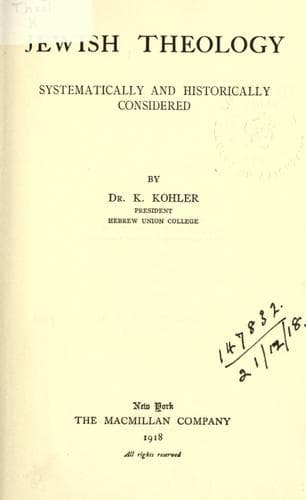
Jewish Theology, Systematically and Historically ConsideredKohler, Kaufmann
Religion
Jewish Theology, Systematically and Historically Considered
Kohler, Kaufmann
Judaism -- Doctrines
8. The apocalyptic writers, who largely influenced the New Testament, and
also the Haggadists refer with fond interest to the banquet of the pious
in the world to come, where they would be served with heavenly manna as
bread, with wine preserved from the days of the creation, and with the
flesh of the Leviathan or the fruit of the Tree of Life.(968) On the other
hand they elaborated the tortures of the evil-doers in hell which are to
afford a pleasing sight to the pious in heaven, just as the torments of
the sinners are aggravated by the sight of the righteous enjoying all
delights.(969) But at the same time we meet with a more refined and
spiritual conception of future reward and punishment among the disciples
of R. Jehuda ha Nasi, in the Babylonian Rab, and the Palestinian R.
Johanan and his pupil Simeon ben Lakish. “In the future world,” says Rab,
“there are no sensual enjoyments nor passions, but the righteous sit at
the table of God with wreaths upon their heads (like the Greek sages at a
symposium!), feeding on the radiance of the divine majesty, as did the
chosen ones of Israel on the heights of Sinai.”(970) R. Johanan teaches,
“All the promises held forth in Scripture in definite form as reward for
the future, refer to the Messianic era, whereas in regard to the bliss
awaiting the pious in the world to come, the words of Isaiah hold good:
‘No eye hath seen it, O God, beside Thee.’ ”(971) Simeon ben Lakish even
went so far as to say, “There is neither hell nor paradise. Instead, God
sends out the sun in its full strength from its encasement, and the wicked
are consumed by its heat, while the pious find delight and healing in its
beams.”(972)
However, the popular imagination demanded more perceptible pictures of
heaven and hell, if fear of punishment was to deter men from sin, and hope
of reward to lead them to virtue. The description of the modes of reward
and punishment for the future in the Koran is the outcome of mingled
Persian and Jewish popular conceptions, and its crass sensuousness exerted
in turn a decisive influence upon the entire Gaonic period,(973) leaving
its mark upon even so clear a thinker as Saadia. Not only does he admit
into his philosophic work all the crude and conflicting descriptions of
the future world, but he also argues for the eternity of the punishments
of hell and of the delights of heaven as logical necessities, because only
such could sufficiently deter or allure mankind, and a righteous God must
certainly carry out His threats and promises.(974)
Public-domain text, read in full here on John Shaqi.
Reviews
Reviews
No reviews yet
Be the first to share your thoughts on this work.
Elsewhere in the archive
Join the Discussion
Join the discussion
Sign in to leave a comment or review.
Sign InorCreate an account