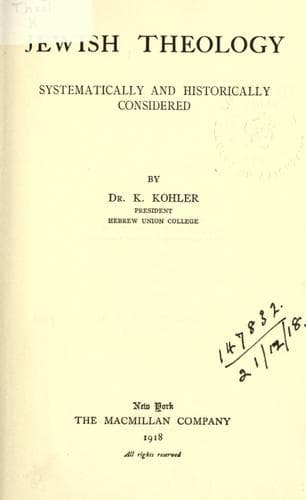
Jewish Theology, Systematically and Historically ConsideredKohler, Kaufmann
Religion
Jewish Theology, Systematically and Historically Considered
Kohler, Kaufmann
Judaism -- Doctrines
9. The entire Jewish philosophy or theology of the Middle Ages remained
under the influence of the traditional belief in resurrection. Even
Maimonides, whose purely spiritual conception of the soul and of salvation
is utterly irreconcilable with the belief in bodily resurrection, and who
accordingly dwells instead, in both his Moreh and his Code, on the future
world of spirits, with explicit emphasis on their incorporeality, did not
have the courage to break altogether with the traditional belief in
resurrection. In his apologetic treatise on resurrection he even attempts
to present it as a miraculous act of God beyond the grasp of the
intellect. He omits, however, to specify what purpose this miracle may
serve, since in the Maimonidean system reward and punishment would be
administered in the world of spirits in a much purer and more satisfactory
manner.(975) The same standpoint is taken also by Jehuda ha Levi as well
as by Crescas and Albo.(976) If then resurrection be a miracle, it falls
outside the scope of philosophic speculation and becomes a matter of
faith; accordingly the mystics from Nahmanides down to Manasseh ben Israel
associated with it the grossest conceptions.(977)
10. The actual view of Maimonides concerning future retribution is
expressed clearly and unambiguously in both his early product, the
commentary on the Mishna, and in the ripest fruit of his life work, the
Mishneh Torah, where he says “Not immortality, but the power to win
eternal life through the knowledge and the love of God is implanted in the
human soul. If it has the ability to free itself from the bondage of the
senses and by means of the knowledge of God to lift itself to the highest
morality and the purest thinking, then it has attained divine bliss, true
immortality, and it enters the realm of the eternal Spirit together with
the angels. If it sinks into the sensuousness of earthly existence, then
it is cut off from eternal life; it suffers annihilation like the beast.
In reality this life eternal is not the future, but is already potentially
present and invariably at hand in the spirit of man himself, with its
constant striving toward the highest. When the rabbis speak of paradise
and hell, describing vividly the delights of the one and the torments of
the other, these are only metaphors for the agony of sin and the happiness
of virtue. True piety serves God neither from fear of punishment nor from
desire for reward, as servants obey their master, but from pure love of
God and truth. Thus the saying of Ben Azai is verified, ‘The reward of a
good deed is the good deed itself.’(978) Only children need bribes and
threats to be trained to morality. Thus religion trains mankind. The
people who cannot penetrate into the kernel need the shell, the external
means of threats and promises.”(979) These splendid words of the great
thinker require supplementing or modification in only one direction, and
Public-domain text, read in full here on John Shaqi.
Reviews
Reviews
No reviews yet
Be the first to share your thoughts on this work.
Elsewhere in the archive
Join the Discussion
Join the discussion
Sign in to leave a comment or review.
Sign InorCreate an account