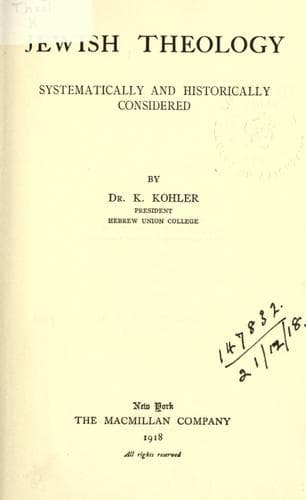
Jewish Theology, Systematically and Historically ConsideredKohler, Kaufmann
Religion
Jewish Theology, Systematically and Historically Considered
Kohler, Kaufmann
Judaism -- Doctrines
1. In every system of belief the object of divine care and guidance is the
individual. His soul and his conscience raise him up, especially according
to the Jewish doctrine, to the divine image, to Godchildship. His freedom
and moral responsibility are the patent of nobility for his divine nature;
his ego, controlling external forces and carrying out its own designs,
vouches for his immortality. Nevertheless the spirit of the Biblical
language indicates rightly that the individual is only a son of man,—_ben
adam_,—that is, a segment or member of the human race, but not the perfect
typical exemplification of the whole of mankind. From the social organism
he receives what he is, what he has, and what he ought to do, both his
nature and his destiny; and only in association with the community and
under the guidance of the highest ideal of humanity can he attain true
perfection. Only mankind as a whole, in its coöperation, as it extends
over the vast expanse of the earth, and in its succession which reaches
through the centuries of the world’s history, can bring to full
development the divine image in man, his moral and religious nature with
all its varied potentialities. It is man collectively who in the first
chapter of Genesis receives the command to subject the earth with all its
creatures to his cultural purposes.(985) In whatever stage of culture we
meet man, his modes of thought and speech, his customs and moral views,
even his spiritual faculties are the result of a long historic process of
development, the product of an extremely complicated past, as well as the
basis of a future which expands in all directions. The ancients expressed
this in their suggestive way, remarking in connection with the verse of
the Psalm, “Thine eyes did see mine unformed substance, and in Thy book
they were all written,”(986) that at the creation of the first man God
recorded the succession of races with their sages, seers and leaders until
the end of time.(987) And when the Haggadists say that in creating man God
took dust from every part of the world, so that he would be everywhere at
home,(988) again they were thinking of mankind. Similarly in the passage
from the Psalms, “Thou hast hemmed me in behind and before,” they explain
that God made the first man with two faces, one looking forward and the
other backward, that is, with a Janus head; and thus they regard man in
his relation to the past and the future, in his historic continuity.(989)
As both physically and spiritually he is the heir of innumerable ancestors
who have transmitted to him with their blood all their idiosyncrasies and
capacities in a peculiar combination, so will he transmit both consciously
and unconsciously the inherited possessions of mankind to future
generations for continued growth or for degeneration. He forms but a link
in the great chain of history, whose goal is the perfected ideal of
humanity, the completed idea of man. This was the underlying thought of
Public-domain text, read in full here on John Shaqi.
Reviews
Reviews
No reviews yet
Be the first to share your thoughts on this work.
Elsewhere in the archive
Join the Discussion
Join the discussion
Sign in to leave a comment or review.
Sign InorCreate an account