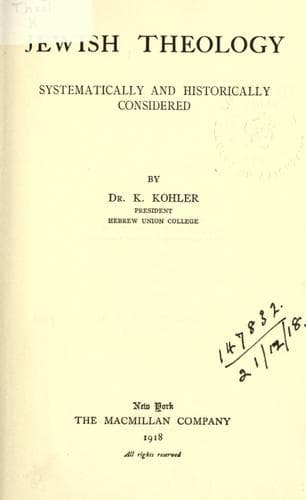
Jewish Theology, Systematically and Historically ConsideredKohler, Kaufmann
Religion
Jewish Theology, Systematically and Historically Considered
Kohler, Kaufmann
Judaism -- Doctrines
that has been afforded by the keenest critic among Jewish philosophers,
Hasdai Crescas. Too deeply enmeshed in the Aristotelian system, Maimonides
found the happiness and immortality of man solely in the acquired
intellectual power which becomes part of the divine intellect, and the
mere knowledge of God is to him tantamount to the blissful enjoyment of
the pious in the radiance of God’s majesty. Consequently those who strive
and soar heavenward through their moral conduct and noble aspirations,
without at the same time being thinkers, receive no reward. Against this
Aristotelian one-sidedness Crescas emphasizes God’s love and goodness for
which the righteous yearn, and in whose pursuit man finds perfection and
happiness. Not for the sake of attaining bliss shall we love God and
practice virtue and truth, but to love God and practice virtue is itself
true bliss. This is the nearness of God referred to by the Psalmist and
declared to be man’s highest good.(980) There is no need of any other
reward than this, and there is no greater punishment than to be deprived
of this boon forever.(981)
11. In the face of these two great thinkers, to whom Spinoza owes the
fundamental ideas of his ethics,(982) the question considered by Albo,
whether the eternal duration of the tortures of hell is reconcilable with
the divine mercy,(983) a question which still plays an important rôle in
Christian theology, and which was probably suggested to Albo through his
disputations with representatives of the Church,—is for us superfluous and
superseded. Our modern conceptions of time and space admit neither a place
or a world-period for the reward and punishment of souls, nor the
intolerable conception of eternal joy without useful action and eternal
agony without any moral purpose. Modern man knows that he bears heaven and
hell within his own bosom. Indeed, so much more difficult is the life of
duty which knows of no other reward than happiness through harmony with
God, the Father of the immortal soul, and of no other punishment than the
soul’s distress at its inner discord with the primal Source and the divine
Ideal of all morality. All the more powerfully is modern man controlled by
the thought that the universe permits no stagnation, no barren enjoyment
or barren suffering, but that every death marks the transition to a higher
goal for greater accomplishment. This yearning of the soul finds
expression in the Talmudic maxim, “The righteous find rest neither in this
world, nor in the world to come, as it is said, ‘They go from strength to
strength, until they appear before God on Zion.’ ”(984)
Chapter XLVI. The Individual and the Race
Public-domain text, read in full here on John Shaqi.
Reviews
Reviews
No reviews yet
Be the first to share your thoughts on this work.
Elsewhere in the archive
Join the Discussion
Join the discussion
Sign in to leave a comment or review.
Sign InorCreate an account