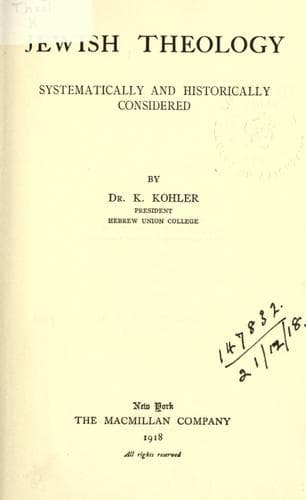
Jewish Theology, Systematically and Historically ConsideredKohler, Kaufmann
Religion
Jewish Theology, Systematically and Historically Considered
Kohler, Kaufmann
Judaism -- Doctrines
3. Clearly, the idea of a world-kingdom of God arose only as the result of
the gradual development of the Jewish God-consciousness. It was necessary
at first that the prophetic idea of God’s kingship, the theocracy in
Israel, should triumph over the monarchical view and absorb it. The
patriarchal life of the shepherd was certainly not favorable to a
monarchical rule. “I will not rule over you, neither shall my son rule
over you, the Lord shall rule over you,” said Gideon in refusing the title
of king which the people had offered him.(1052) According to one tradition
Samuel blamed the people for desiring a king and thereby rejecting the
divine kingship.(1053) “I give thee a king in Mine anger,” says God
through Hosea.(1054) The more the monarchy, with its exclusively worldly
and materialistic aims, came into conflict with the demands of the
prophets and their religious truth, the higher rose the prophetic hope for
the dawning of a day when God alone would rule in absolute sovereignty
over the entire world. Now, in the kingdom of the Ten Tribes, with its
frequently changing dynasties, the old patriarchal conception was
dominant, while in the kingdom of Judah, which remained loyal to the house
of David, the monarchical idea developed. Isaiah, living in Jerusalem and
favorably disposed towards the monarchy, prophesied that a shoot from the
house of David, endowed with marvelous spiritual powers, should come
forth, occupying the throne in the place of God, and through his victories
would plant righteousness and the knowledge of God everywhere upon earth,
and establish throughout the world a wonderful reign of peace.(1055) Upon
this royal “shoot” of David(1056) rested the Messianic hope during the
Exile, and amidst the disappointments of the time this vision became all
the more idealized. In contrast to this the great prophet of the Exile
announced the establishment of the absolute dominion of God as the true
“King of Israel”(1057) over all the earth by the nucleus of Israel, “the
servant of God,” who would become conscious of his great historic mission
in the world and be willing to offer his very life in its cause. In all
this the prophet makes no reference to the royal house of David, but makes
bold to confer the title of the “anointed of God”—that is, Messiah—upon
Cyrus, the king of Persia, as the one who was to usher in the new
era.(1058) Subsequently these two divergent hopes for the future run
parallel in the Psalms and the liturgy as well as in the apocryphal and
rabbinic literature.
Public-domain text, read in full here on John Shaqi.
Reviews
Reviews
No reviews yet
Be the first to share your thoughts on this work.
Elsewhere in the archive
Join the Discussion
Join the discussion
Sign in to leave a comment or review.
Sign InorCreate an account