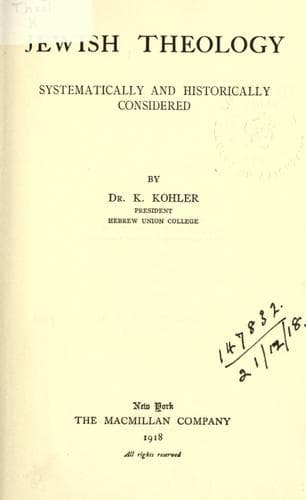
Jewish Theology, Systematically and Historically ConsideredKohler, Kaufmann
Religion
Jewish Theology, Systematically and Historically Considered
Kohler, Kaufmann
Judaism -- Doctrines
4. While the Messianic aspirations as such bore rather a political and
national character in Judaism (as will be explained in Chapter LIII), yet
the religious hope for a universal kingdom of God took root even more
deeply in the heart of the Jewish people. It created the conception of
Israel’s mission and also the literature and activity of the Hellenistic
propaganda, and it gave a new impetus to the making of proselytes among
the heathen, to which both Christianity and Islam owe their existence. The
words of Isaiah, repeated later by Habakkuk, “The earth will be full of
the knowledge of the Lord, as the waters cover the sea,”(1059) became now
an article of faith. While in earlier times the rule of Israel’s God,
JHVH, was attached to Zion, from whose holy mount He ruled as invisible
King,(1060) later on we find Zechariah proclaiming Him who was enthroned
in heaven as having dominion over the entire earth,(1061) and the Psalter
summons all nations to acknowledge, adore, and extol Him as King of the
world.(1062) Nay, at the very time when Judah lay humbled to the ground,
the prophet exclaimed, “Who would not fear Thee, O King of the nations?
for it befitteth Thee; forasmuch as among all the wise men of the nations,
and in all their royalty there is none like unto Thee.”(1063) Israel’s
great hope for the future is expressed most completely and in most sublime
language in the New Year liturgy: “O Lord our God, impose Thine awe upon
all Thy works, and let Thy dread be upon all that Thou hast created, that
they may all form one single band to do Thy will with a perfect heart....
Our God and God of our fathers, reveal Thyself in Thy splendor as King
over all the inhabitants of the world, that every handiwork of Thine may
know that Thou hast made it, and every creature may acknowledge that Thou
hast created it, and whatsoever hath breath in its nostrils may say: the
Lord God of Israel is King, and His dominion ruleth over all.”(1064)
Public-domain text, read in full here on John Shaqi.
Reviews
Reviews
No reviews yet
Be the first to share your thoughts on this work.
Elsewhere in the archive
Join the Discussion
Join the discussion
Sign in to leave a comment or review.
Sign InorCreate an account