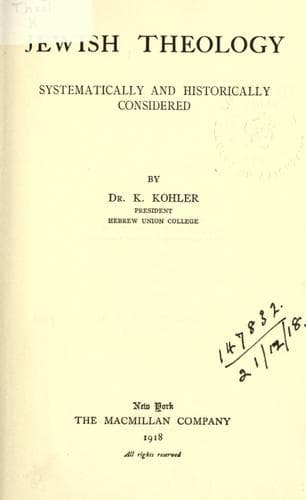
Jewish Theology, Systematically and Historically ConsideredKohler, Kaufmann
Religion
Jewish Theology, Systematically and Historically Considered
Kohler, Kaufmann
Judaism -- Doctrines
load was to the Jew a source of pride in the consciousness of his divine
election.(1118)
6. But most significant in the character and development of Judaism is the
fact that all the leading ideas and motives which emanated from the
priesthood of the Jewish people were concentrated in one single focus, the
_hallowing of the name of God_. Two terms expressed this idea in both a
negative and a positive form, the warning against “_Hillul ha
Shem_”—profanation of the name of God—and the duty of “_Kiddush ha
Shem_”—sanctification of God’s name. These exerted a marvelous power in
curbing the passions and self-indulgence of the Jew and in spurring him on
to the greatest possible self-sacrifice and to an unparalleled willingness
to undergo suffering and martyrdom for the cause. These terms are derived
from the Biblical verse, “Ye shall not profane My holy name, but I will be
hallowed among the children of Israel; I am the Lord who halloweth
you.”(1119) This verse forms the concluding sentence of the precepts for
the Aaronitic priesthood and warns them as the guardians of the sanctuary
to do nothing which might in the popular estimation degrade them or the
divine cause intrusted to them. When, however, during the Maccabean wars,
the little band of the pious proved themselves to be the true priesthood
in their Opposition to the faithless Aaronites, offering their very lives
as a sacrifice for the preservation of the true faith in God, the
Scriptural word received a new and higher meaning. It came to signify the
obligation of the entire priest-people to consecrate the name of God by
the sacrifice of their lives, and also their duty to guard against its
profanation by any offensive act. In connection with this Scriptural
passage the sages represent God as saying, “I have brought you out of
Egypt only on the condition that you are ready to sacrifice your lives, if
need be, to consecrate My name.”(1120) From that period it became a duty
and even a law of Judaism, as Maimonides shows in his Code, for each
person in life and in death to bear witness to His God.(1121) “Ye are My
witnesses, saith the Lord, and I am God”(1122)—and witnesses being in the
Greek version martyrs, the word afterward received the meaning of
“blood-witnesses.”—This passage of the prophet is commented on by Simeon
ben Johai, one of the great teachers who suffered under Hadrian’s
persecution, in the following words, “If ye become My witnesses, then am I
your Lord, God of the world; but if ye do not witness to Me, I cease to
be, as it were, the Lord, God of all the world.”(1123) That is to say, it
is the martyrdom of the pious which glorifies God’s name before all the
world. Or, as Felix Perles says so beautifully, “As every good and noble
man must ever bear in mind that the dignity of humanity is intrusted to
his hand, so should each earnest adherent of the Jewish faith remember
that the glory of God is intrusted to his care.”(1124) The Jewish people
Public-domain text, read in full here on John Shaqi.
Reviews
Reviews
No reviews yet
Be the first to share your thoughts on this work.
Elsewhere in the archive
Join the Discussion
Join the discussion
Sign in to leave a comment or review.
Sign InorCreate an account