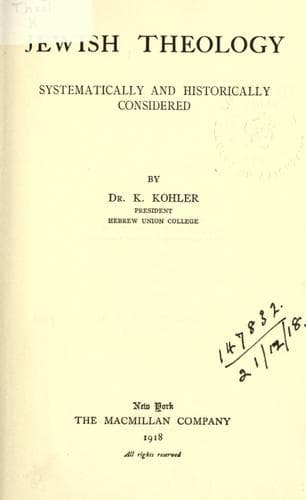
Jewish Theology, Systematically and Historically ConsideredKohler, Kaufmann
Religion
Jewish Theology, Systematically and Historically Considered
Kohler, Kaufmann
Judaism -- Doctrines
5. The chief effort of the pious, the founders of the Judaism of the
Synagogue, was to keep the Jewish people from the demoralizing influences
of pagan nature-worship, represented first by Semitic and later by Greek
culture. The leaders of the Pharisees “built a fence about the law”(1114)
extending the prohibition of mingling with the heathen nations so as also
to prohibit eating with them and participating in their feasts and social
gatherings,—not for the preservation of the Jewish race merely, as
Christian theologians maintain, but for the sake of keeping its inner life
intact and pure.(1115) “God surrounded us with brazen walls, hedged us in
with laws of purity in regard to food and drink and physical contact, yea,
even to that which we see and hear, in order that we should be pure in
body and soul, free from absurd beliefs, not polluted by contact with
others or through association with the wicked; for most of the peoples
defile themselves with their sexual practices, and whole lands pride
themselves upon it. But we hold ourselves aloof from all this”—so spoke
Eleazar the priest to King Ptolemy Philadelphus, according to the Letter
of Aristeas, thus giving expression to the sentiment most deeply rooted in
the souls of the pious of that period.(1116) They strove to build up a
nation of whom the Tannaim could say, “Whoever possesses no sense of shame
and chastity, of him it is certain that his ancestors did not stand at
Sinai.”(1117)
Naturally enough, the Greek and Roman people took offense at this
aloofness and separation from every contact with the outer world, and
explained it as due to a spirit of hostility to mankind. Even up to the
present it has been the lot of Jewry and Judaism to be misunderstood by
the world at large, to be the object of either its hate or its pity. The
world disregards the magnificence of the plan by which an entire people
were to be reared as a priest-nation, as citizens of a kingdom of God,
among whom, in the course of centuries, the seed of prophetic truth was to
germinate and sprout forth for the salvation of humanity. If, in complete
contrast to heathen immorality, the Jew in his life, his thinking, and his
will was governed by the strictest moral discipline; if, in spite of the
most cruel persecutions and the most insidious temptations, the Jewish
people remained steadfast to its pure belief in God and its traditional
standards of chastity, exhibiting a loyalty which amazed the nations and
the religious sects about, but was neither understood nor followed by
them, this was mainly due to the hallowing influences of the priestly
laws. They steeled the people for the fulfillment of their duty and
shielded them against all hostile powers both within and without. The very
_burden_ of the law, so bitterly denounced by Christianity since the time
of Paul, lent Judaism its dignity at all times, protecting it from the
assaults of the tempter; and that which seemed to the outsider a heavy
Public-domain text, read in full here on John Shaqi.
Reviews
Reviews
No reviews yet
Be the first to share your thoughts on this work.
Elsewhere in the archive
Join the Discussion
Join the discussion
Sign in to leave a comment or review.
Sign InorCreate an account