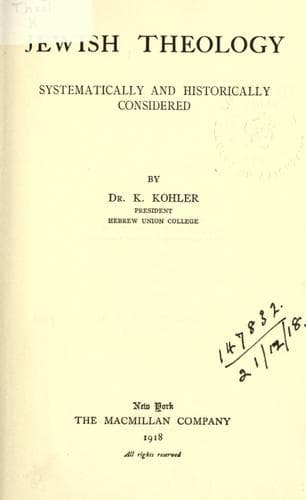
Jewish Theology, Systematically and Historically ConsideredKohler, Kaufmann
Religion
Jewish Theology, Systematically and Historically Considered
Kohler, Kaufmann
Judaism -- Doctrines
3. But, as light by its very nature illumines its surroundings, so the
Torah in the possession of the Jewish people was certain to become the
light of mankind. First of all, the book of Law itself insists that the
father shall teach the word of God to his children, using many signs and
ceremonies that they may meditate on the works of God and walk in the path
of virtue, and that the divine commands should be “in the mouth and in the
heart of all to do them.”(1144) It was made incumbent upon the high priest
or king to read the Law at least once every seven years to the whole
people assembled in the holy city for the autumnal festival,—men, women,
children, and the sojourners in the gates,—so that it should become their
common property.(1145) This precept probably gave rise to the triennial
and later the annual system of Torah reading on the Sabbath. But in
addition to the book of Law the prophetic words of consolation were read
to the people, a custom which originated in the Babylonian exile, and was
continued under the name of _Haftarah_ (“dismissal” of the
congregation).(1146) The seer of the exile refers to these prophetic words
of comfort which were offered to the people on the Sabbath as well as
other feasts and fasts: “Attend unto Me, O My people, and give ear unto
Me, O My nation, for instruction (Torah) shall go forth from Me, and My
right on a sudden for a light of the people.... Hearken unto Me, ye that
know righteousness, the people in whose heart is My law; fear ye not the
taunt of men, neither be ye dismayed at their revilings. For the moth
shall eat them up like a garment, and the worm shall eat them like wool;
but My favor shall be forever, and My salvation unto all
generations.”(1147) Moved by such stirring ideals, Synagogues arose in
Jewish settlements all over the globe, and the book of the Law, in its
vernacular versions, Greek and Aramaic, together with the words of the
prophets, became the general source of instruction. In the words of the
Psalms, it became “the testimony of the Lord, making wise the simple,”
“rejoicing the heart,” “enlightening the eyes,” “more to be desired than
gold.”(1148) Nay more, the study of the Law became the duty of every man,
and he who failed to live up to the precepts of the devotees of the Law,
the Pharisean fellowships, was scorned as belonging to the lower class,
_am haaretz_. Every morning the pious Jew, first thanking God for the
light of day, followed this up by thanking Him for the Torah, which
illumines the path of life. “The welfare of society rests upon the study
of the Law, divine service and organized charity,” was a saying of Simon
the Just, a high priest of the beginning of the third pre-Christian
century.(1149) Thus learning and teaching became leading occupations for
the Jew, and the two main departments of Jewish literature,
correspondingly, are _Torah_ and _Talmud_, that is, the written Law and
its exposition. Indeed, the highest title which the rabbis could find for
Public-domain text, read in full here on John Shaqi.
Reviews
Reviews
No reviews yet
Be the first to share your thoughts on this work.
Elsewhere in the archive
Join the Discussion
Join the discussion
Sign in to leave a comment or review.
Sign InorCreate an account