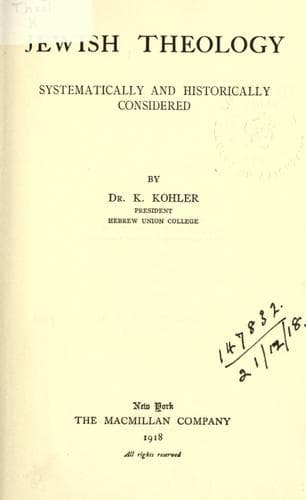
Jewish Theology, Systematically and Historically ConsideredKohler, Kaufmann
Religion
Jewish Theology, Systematically and Historically Considered
Kohler, Kaufmann
Judaism -- Doctrines
Moses was simply “Moses our Teacher.” Nay, God Himself was frequently
represented as a venerable Master, teaching the Law in awful
majesty.(1150)
4. Later under the successive influence of Babylonian and Greek culture,
the wisdom literature was added to the Prophets and the Psalms, giving to
the whole Torah a universal scope, like that claimed for Greek philosophy.
The Jewish love of learning led to an ever greater longing for truth by
adding the wisdom of other cultured nations to its own store of knowledge.
This motive for universalism became all the stronger, as the faith became
more centered in the sublime conception of God as Master of all the world.
As the God of Israel appeared the primal source of all truth, so the
revealed word of God was considered the very embodiment of divine
wisdom.(1151) In fact, the men of hoary antiquity described in the opening
chapters of Genesis were actually credited with being the instructors of
the Greeks and other nations.(1152) We read a strange story by a pupil of
Aristotle that the great sage admired a Jew, whom he happened to meet, as
both wise and pious, so that the little Jewish nation was often
considered, like the wise men of India, to be a sect of
philosophers.(1153) Indeed, Judaism became a matter of curiosity to the
pagan world on account of the Synagogue, which attracted them as a unique
center of religious devotion and instruction, and especially because of
the Bible, which was read and expounded in its Greek garb from Sabbath to
Sabbath. The Jewish people raised themselves to be a nation of thinkers,
and largely through association with Greek thought. For example, in the
Greek translation of the Scriptures all anthropomorphic expressions are
avoided. As the personal name of Israel’s God of the covenant, *JHVH*, was
replaced by the name _Adonai_, “the Lord,”(1154) the universality of the
Jewish God became still more evident. Thus the pagan world could find God
in the Scriptures to be the living God who dwells in the heart and is
sought by all mankind. The Jew became the herald of the One God of the
universe, his Bible a book of universal instruction. Many of the heathen,
without merging themselves into the community of the covenant people and
without accepting all its particularistic customs, rallied around its
central standard as simple theists, “worshipers of God,” or “they who fear
the Lord,” according to the terminology of the Psalms.(1155)
Public-domain text, read in full here on John Shaqi.
Reviews
Reviews
No reviews yet
Be the first to share your thoughts on this work.
Elsewhere in the archive
Join the Discussion
Join the discussion
Sign in to leave a comment or review.
Sign InorCreate an account