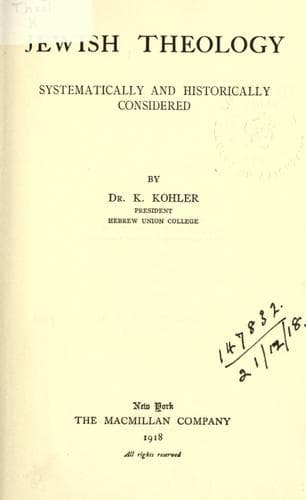
Jewish Theology, Systematically and Historically ConsideredKohler, Kaufmann
Religion
Jewish Theology, Systematically and Historically Considered
Kohler, Kaufmann
Judaism -- Doctrines
5. An old rabbinical legend, which is reflected in the New Testament
miracle of Pentecost, relates that the Ten Words of Sinai were uttered in
seventy tongues of fire to reach the known seventy nations of the
earth.(1156) We are told that when the people entered Canaan, the words of
the Law were engraved in seventy languages on the stones of the altar at
Mount Ebal.(1157) That is, the law of Sinai was intended to provide the
foundation for all human society. One Haggadist even asserts that the
heathen nations all refused to accept the Law, and if Israel also had
rejected it, the world would have returned to chaos.(1158) Israel was, so
to speak, _forced_ by divine Providence to accept the Law on behalf of the
entire race. Hillel, under the Romanized reign of Herod, was fully
conscious of this world-mission when he said: “Love your fellow creatures
and lead them to the study of the Law.”(1159)
6. The outlook for the Jewish people, however, became darker and darker
through its struggle with Rome. The fanatical Zealots entirely opposed the
spreading of the knowledge of the Torah among those who did not belong to
the household of Israel.(1160) Then the Church sent forth her missionaries
to convert the pagan world by constant concessions to its polytheistic
views and practices. The seed sown by Hellenistic Judaism yielded a rich
harvest for the Church, even though it was won at the sacrifice of pure
Jewish monotheism. The Ten Words of Sinai, the Mosaic laws of marriage,
the poor laws, and other Biblical statutes became the cornerstone of
civilization, but in a different guise; the heritage of Judaism was
transplanted to the Christian and Mohammedan world in a new garb and under
a new name. Henceforth the Jew, dispersed, isolated, and afflicted, had to
struggle to preserve his faith in its pristine purity. The very danger
besetting the study of the Law during the Hadrianic persecutions, which
followed the Bar Kochba revolt, increased his zeal and courage. “Devoid of
the Torah, our vital element, we are surely threatened with death,” said
Rabbi Akiba, applying to himself the fable of the fox and the fishes, as
he defied the Roman edict.(1161) The fear lest the Torah should be
forgotten, stimulated the teachers and their disciples ever anew to its
pursuit. The Torah was regarded as the bond and pledge of God’s nearness;
hence the many rabbinical sayings concerning its value in the eyes of God,
which are frequently couched in poetic and extravagant language.(1162) The
underlying idea of them all is that Israel could dispense with its State
and its Temple, but not with its storehouse of divine truth, from which it
constantly derives new life and new youth.
Public-domain text, read in full here on John Shaqi.
Reviews
Reviews
No reviews yet
Be the first to share your thoughts on this work.
Elsewhere in the archive
Join the Discussion
Join the discussion
Sign in to leave a comment or review.
Sign InorCreate an account