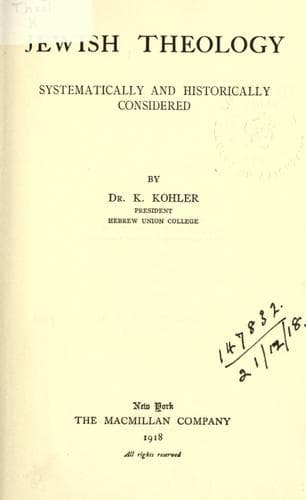
Jewish Theology, Systematically and Historically ConsideredKohler, Kaufmann
Religion
Jewish Theology, Systematically and Historically Considered
Kohler, Kaufmann
Judaism -- Doctrines
1. “If there are ranks in suffering, Israel takes precedence. If the
duration of sorrows and the patience with which they are borne, ennoble,
the Jews are among the aristocracy of every land. If a literature is
called rich which contains a few classic tragedies, what shall we say to a
national tragedy lasting for fifteen hundred years, in which the poets and
the actors are also the heroes?” With these classic words Leopold Zunz
introduces the history of sufferings which have occasioned the hundreds of
plaintive and penitential songs of the Synagogue described in his book,
_Die Synagogale Poesie des Mittelalters_. They are the cries of a nation
of martyrs, resounding through the whole Jewish liturgy, and appearing
already in many of the Psalms: “Thou hast given us like sheep to be eaten;
and hast scattered us among the nations. Thou makest us a taunt to our
neighbors, a scorn and a derision to them that are round about us. All
this is come upon us, yet have we not forgotten Thee, neither have we been
false to Thy covenant: Nay, for Thy sake are we killed all the day; we are
accounted as sheep for the slaughter. Awake, why sleepest Thou, O Lord?
Arouse Thyself, cast not off forever. Wherefore hidest Thou Thy face, and
forgettest our affliction and our oppression?”(1170) Thus the congregation
of Israel laments; and what is the answer of Heaven?
2. The Bible contains two answers: the first by Ezekiel, priest and
prophet; the other by the great unknown seer of the Exile whose words of
comfort are given in the latter part of Isaiah. Ezekiel gave a stern and
direct answer: “The nations shall know that the house of Israel went into
captivity because of their iniquity, because they broke faith with Me, and
I hid My face from them; so I gave them into the hand of their
adversaries, and they fell all of them by the sword. According to their
uncleanness and according to their transgressions did I unto them; and I
hid My face from them. Therefore thus saith the Lord God: Now will I bring
back the captivity of Jacob, and have compassion upon the whole house of
Israel; and I will be jealous for My holy name. And they shall bear their
shame, and all their breach of faith which they committed against
Me.”(1171) These words are echoed in the harrowing admonitory chapter of
Leviticus, which, however, closes with words of comfort: “And they shall
confess their iniquity ... if then perchance their uncircumcised heart be
humbled, and they then be paid the punishment of their iniquity; then will
I remember My covenant with Jacob, and also My covenant with Isaac, and
also My covenant with Abraham will I remember; and I will remember the
land.”(1172) This view of divine justice as external and punitive was
basic to the Synagogue liturgy and the entire rabbinic system. The
priestly idea of atonement, that sin could be wiped out by sacrifice, made
a profound impression, not only upon individual sinners, but also upon the
nation.
Public-domain text, read in full here on John Shaqi.
Reviews
Reviews
No reviews yet
Be the first to share your thoughts on this work.
Elsewhere in the archive
Join the Discussion
Join the discussion
Sign in to leave a comment or review.
Sign InorCreate an account