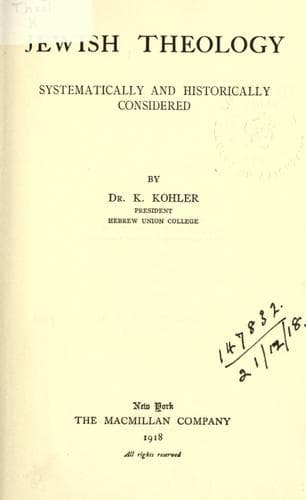
Jewish Theology, Systematically and Historically ConsideredKohler, Kaufmann
Religion
Jewish Theology, Systematically and Historically Considered
Kohler, Kaufmann
Judaism -- Doctrines
Hence it was applied especially to the people in exile when they
could not bring sacrifices to their God. Still, one means of atonement
remained, the exile itself, which could lead the people to repentance and
finally to God’s forgiveness.(1173) Thus the people retained a hope of
return from their captivity. They were assured by their prophetic monitors
that the faithful community of the Lord would again be received in favor
by the God of faithfulness. They even built their hope upon the portions
of the Law, which was read to assembled worshipers that they might know
and observe it on their return to the land of their fathers. Israel could
say with the Psalmist: “Unless Thy law had been my delight, I should then
have perished in mine affliction.”(1174) According to a Palestinian
Haggadist, “Israel would never have persevered so long, had not the Torah,
the marriage contract of Israel with its God, pledged to it a glorious
future on the holy soil.”(1175) Wait patiently for God’s mercy, which in
His own time will rebuild Israel’s State and Temple!—this is the keynote
of all the prayers and songs of the Synagogue.
3. But the great seer of the exile, whose anonymity lends still greater
impressiveness to his words of comfort, stood on a higher historical plane
than that of Ezekiel the priest. He witnessed the transformation of the
entire political world of his time through the victory of Cyrus the Mede
over the Babylonian empire, and thus was able to attain a profounder grasp
of the destiny of his own nation. Hence he was not satisfied with the view
of Ezekiel. The latter had applied the popular saying, “The fathers have
eaten sour grapes, and the children’s teeth are set on edge,”(1176) to
refute the belief that an individual was punished for the sins of his
fathers; but he failed to extend this doctrine to the whole nation.
Whatever sins were committed by the generation who were exiled, their
children ought not to suffer for them “in double measure.”(1177) Moreover,
the realm of love has a higher law than atonement through retribution.
Love brings its sacrifice without asking why. By willing sacrifice of self
it serves its higher purpose. He who struggles and suffers silently for
the good and true is _God’s servant_, who cannot perish. He attains a
higher glory, transcending the fate of mortality. This is the new
revelation that came to the seer, as he pondered on the destiny of Israel
in exile, illumining for him that dark enigma of his people’s tragic
history.
Public-domain text, read in full here on John Shaqi.
Reviews
Reviews
No reviews yet
Be the first to share your thoughts on this work.
Elsewhere in the archive
Join the Discussion
Join the discussion
Sign in to leave a comment or review.
Sign InorCreate an account