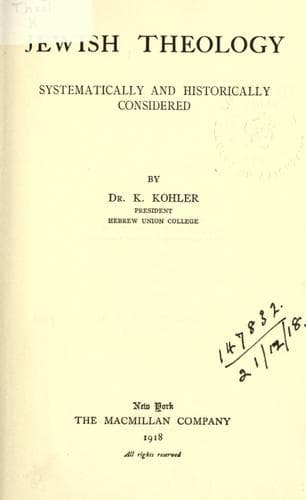
Jewish Theology, Systematically and Historically ConsideredKohler, Kaufmann
Religion
Jewish Theology, Systematically and Historically Considered
Kohler, Kaufmann
Judaism -- Doctrines
The problem of suffering, especially that of the servant of God, or the
pious, occupied the Jewish mind ever since the days of Jeremiah and
especially during the exile. The author of the book of Job elaborated this
into a great theodicy, speaking of Job also as the “servant of the
Lord.”(1178) Whatever pattern our exilic seer employed, beside the
chapters about the Servant of the Lord,(1179) whatever tragic fate of some
great contemporary the plaintive song in the fifty-second and fifty-third
chapters referred to (some point to Jeremiah, others to Zerubabel),(1180)
or whether the poet had in mind only the tragic fate of Israel, as many
modern exegetes think; in any case he conceived the unique and pathetic
picture of Israel as the suffering Servant of the Lord, who is at last to
be exalted:(1181)
“Behold, My servant shall prosper, he shall be exalted and lifted up, and
shall be very high. According as many were appalled at thee—so marred was
his visage unlike that of a man, and his form unlike that of the sons of
men—so shall he startle many nations; kings shall shut their mouths
because of him; for that which had not been told them they shall see, and
that which they had not heard shall they perceive. Who would have believed
our report? And to whom hath the arm of the Lord been revealed? For he
shot up right forth as a sapling, and as a root out of a dry ground; he
had no form nor comeliness, that we should look upon him, nor beauty that
we should delight in him. He was despised and forsaken of men, a man of
pains, and acquainted with disease, and as one from whom men hide their
face; he was despised, and we esteemed him not. Surely our diseases he did
bear, and our pains he carried; whereas we did esteem him stricken,
smitten of God and afflicted. But he was wounded because of our
transgressions, he was crushed because of our iniquities; the chastisement
of our welfare was upon him, and with his stripes we were healed. All we,
like sheep, did go astray, we turned every one to his own way; and the
Lord hath made to light on him the iniquity of us all. He was oppressed,
though he humbled himself, and opened not his mouth; as a lamb that is led
to the slaughter, and as a sheep that before her shearers is dumb; yea, he
opened not his mouth. By oppression and judgment he was taken away, and
with his generation who did reason? For he was cut off out of the land of
the living, for the transgression of my people to whom the stroke was due.
And they made his grave with the wicked, and with the rich his tomb;
although he had done no violence, neither was any deceit in his mouth. Yet
it pleased the Lord to crush him by disease; to see if his soul would
offer itself in restitution, that he might see his seed, prolong his days,
and that the purpose of the Lord might prosper by his hand. Of the travail
of his soul he shall see to the full, even My servant, who by his
knowledge did justify the Righteous One to the many, and their iniquities
he did bear.
Public-domain text, read in full here on John Shaqi.
Reviews
Reviews
No reviews yet
Be the first to share your thoughts on this work.
Elsewhere in the archive
Join the Discussion
Join the discussion
Sign in to leave a comment or review.
Sign InorCreate an account