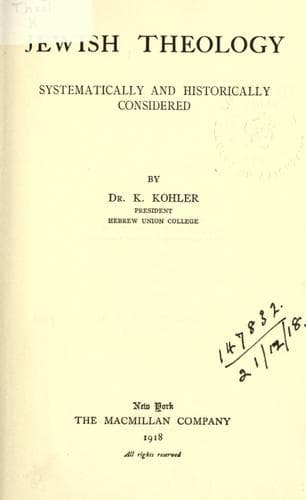
Jewish Theology, Systematically and Historically ConsideredKohler, Kaufmann
Religion
Jewish Theology, Systematically and Historically Considered
Kohler, Kaufmann
Judaism -- Doctrines
This pattern of the ideal ruler may have been modeled after some ancient
Babylonian formula for the adoration of kings, as has been asserted of
late; and the same may be true of the mystic titles given by Isaiah to the
royal heir: “Wonderful counselor, divine hero, father of spoil, prince of
peace.”(1200) When the little kingdom of Judæa fell, the prospect of a
realization of the great prophetic vision seemed gone forever. Therefore
the exiles in Babylon fastened their hopes so much more firmly on the
“Shoot,” particularly on Zerubabel (“the seed born in Babylon”), the
object of the fondest hopes of the later prophets.(1201) When he, too,
disappointed their expectations, probably due to Persian interference,
they transferred the advent of the Messiah more and more into the realm of
miracle, and popular fancy dwelt fondly on his appearance as God’s
champion against the hosts of heathendom (Gog and Magog).(1202)
4. The conception of the priest-prophet Ezekiel is very significant in
this connection; for him the kingdom of Israel’s God could only be
established by the restoration of the throne of David, the servant of the
Lord, and by the utter destruction of the hosts of heathendom, who were
hostile to both God and Israel. In accordance with this hope the author of
the second Psalm presents a dramatic picture of the Messiah triumphing
over the heathen nations, a picture which became typical for all the
future. “Why are the nations in an uproar? And why do the peoples mutter
in vain? The kings of the earth stand up, and the rulers take counsel
together against the Lord, and against His anointed: ‘Let us break their
bands asunder, and cast away their cords from us.’ He that sitteth in
heaven laugheth, the Lord hath them in derision. Then will He speak unto
them in His wrath, and affright them in His sore displeasure: ‘Truly it is
I that have established My king upon Zion, My holy mountain.’ I will tell
of the decree: The Lord said unto me: ‘Thou art My son, this day have I
begotten thee. Ask of Me, and I will give the nations for thine
inheritance, and the ends of the earth for thy possession. Thou shalt
break them with a rod of iron; thou shalt dash them in pieces like a
potter’s vessel.’ ” Henceforth the conception of the Messiah alternated
between Isaiah’s prince of peace and the world-conqueror of the
Psalmist.(1203) The name Messiah does not occur in Scripture in the
absolute form, but always occurs in the construct with JHVH or a pronoun,
signifying “the Anointed of the Lord.” Accordingly, it expresses the
relation of the Anointed to God, his sovereign, in striking contrast to
the heathen kings who themselves claimed adoration as gods. The very name
Messiah excludes the possibility of deification. The term Messiah was used
with the article only in much later times, _ha Meshiah_, or in the
Aramaic, _Meshiha_, from which we derive the name, Messiah.
Public-domain text, read in full here on John Shaqi.
Reviews
Reviews
No reviews yet
Be the first to share your thoughts on this work.
Elsewhere in the archive
Join the Discussion
Join the discussion
Sign in to leave a comment or review.
Sign InorCreate an account