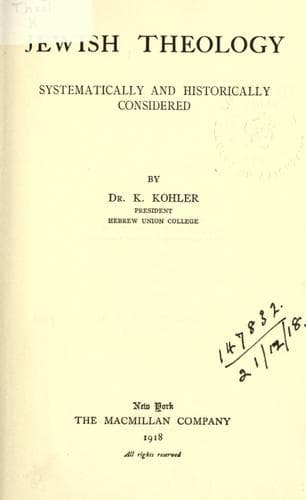
Jewish Theology, Systematically and Historically ConsideredKohler, Kaufmann
Religion
Jewish Theology, Systematically and Historically Considered
Kohler, Kaufmann
Judaism -- Doctrines
5. In the course of time, however, as the people waited in vain for a
redeemer, the expected Messiah was lifted more and more into the realm of
the ideal. The belief took hold especially in the inner circle of the
pious (Hasidim) that the Messiah was hidden somewhere, protected by God,
to appear miraculously after having vanquished the hostile powers. The
Essenes, the representatives of the secret lore, developed this conception
in the Apocalyptic writings, thus giving the Messiah a certain cosmic or
supernatural character. They probably modeled their thoughts upon the
Zoroastrian system, where _Soshiosh_, the world savior, would appear in
the last millennium as the messenger of Ormuzd to destroy forever the
kingdom of evil and establish the dominion of the good.(1204) Thus, when
Isaiah says of the Messiah that “by the breath of his mouth he shall slay
the wicked,” this is referred to the principle of evil, Satan or Belial,
who was sometimes actually identified with the Persian Ahriman.(1205)
Moreover, after the Persian system, the whole process of history was
divided into six millenniums of strife between the principle of good and
evil, represented by the Torah and the ungodliness of the world, and a
seventh millennium, the kingdom of God or the Messianic age. The dates of
these were calculated upon the basis of the book of Daniel, with its four
world-kingdoms and mysterious numbers.(1206)
6. The Biblical passages which refer to “the end of days” were also
connected with the advent of the Messianic age, and the so-called
eschatological writings speak of fixed periods following one another. In
accordance with certain prophetic hints, they expected first the
“birth-throes”(1207) or “vestiges” of the Messianic age, a great physical
and moral crisis with the turmoil of nature, plagues, and moral
degeneracy. Before the Messiah would suddenly appear from his hiding
place, the prophet Elijah was to return from heaven, whither he had
ascended in a fiery chariot. But, while he had lived in implacable wrath
against idolaters, he was now to come as a messenger of peace, reconciling
the hearts of Israel with God and with one another, preparing the way to
repentance, and thus to the redemption and reunion of Israel.(1208) The
next stage is the gathering together of Israel from all corners of the
earth to the holy land under the leadership of the Messiah, summoned by
the blast of the heavenly trumpet.(1209) Then begins that gigantic warfare
on the holy soil between the hosts of Israel and the vast forces of
heathendom led by the half-mystic powers of Gog and Magog, a conflict
which, according to Ezekiel, is to last for seven years and to end with
the annihilation of the powers of evil. Before the real Messiah, the son
of David, appears in victory, another Messiah of the tribe of Ephraim is
to fall in battle, according to a belief dating from the second century
and possibly connected with the Bar Kochba war.(1210) In another
Public-domain text, read in full here on John Shaqi.
Reviews
Reviews
No reviews yet
Be the first to share your thoughts on this work.
Elsewhere in the archive
Join the Discussion
Join the discussion
Sign in to leave a comment or review.
Sign InorCreate an account