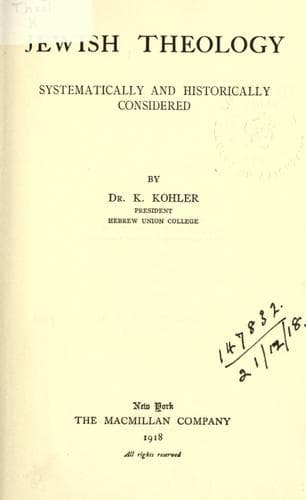
Jewish Theology, Systematically and Historically ConsideredKohler, Kaufmann
Religion
Jewish Theology, Systematically and Historically Considered
Kohler, Kaufmann
Judaism -- Doctrines
tradition, probably older, the true Messiah himself is to suffer and
die.(1211) At all events, he must destroy Rome, the fourth world-kingdom.
But he is also to slay the arch-fiend Ahriman, afterwards known as
Armillus. Moreover, he will redeem the dead from Sheol, as he possesses
the key to open all the graves of the holy land, and thus all the sons of
Israel will partake in the glory of his kingdom. Then at last the city of
Jerusalem will arise in splendor, built of gold and precious stones, the
marvel of the world, and in its midst the Temple, a structure of
surpassing magnificence. The holy vessels of the tabernacle, hidden for
ages in the wilderness, will appear, and the nations will offer the wealth
of the whole earth as their tribute to the Messiah. All will practice
righteousness and piety, and will be rewarded by bliss and numerous
posterity.(1212)
Opinions differ widely as to the duration of the Messianic age. They range
from forty to four hundred years, and again from three generations to a
full millennium.(1213) This difference is partly caused by the distinction
between the national hope, with the temporary welfare of the people of
Israel, and the religious hope concerning the divine kingdom, which is to
last forever. A very late rabbinic belief holds that the Messiah will be
able to give a new law and even to abrogate Mosaic prohibitions.(1214)
7. At any rate, no complete system of eschatology existed during the
Talmudic age, as the views of the various apocalyptic writers were
influenced by the changing events of the time and the new environments,
with their constant influence upon popular belief. A certain uniformity,
indeed, existed in the fundamental ideas. The Messianic hope in its
national character includes always the reunion of all Israel under a
victorious ruler of the house of David, who shall destroy all hostile
powers and bring an era of supreme prosperity and happiness as well as of
peace and good-will among men. The Haggadists indulged also in dreams of
the marvelous fertility of the soil of Palestine in the Messianic
time,(1215) and of the resurrection of the dead in the holy land. But in
Judaism such views could never become dogmas, as they did in the Church,
even though they were common in both the older and younger Haggadah. These
national expectations were expressed in the liturgy by the Eighteen
Benedictions, composed by the founders of the Synagogue, the so-called Men
of the Great Synagogue; here the prayers for “the gathering of the
dispersed” and the “destruction of the kingdom of Insolence” precede those
for the “rebuilding of Jerusalem and the restoration of the throne of
David.” But the mystic speculations on the origin, activity, and sojourn
of the Messiah, which were a favorite theme of the apocalyptic writers and
the Haggadists during the pre-Christian and the first Christian centuries,
gave way to a more sober mode of thought, in the disappointment that
Public-domain text, read in full here on John Shaqi.
Reviews
Reviews
No reviews yet
Be the first to share your thoughts on this work.
Elsewhere in the archive
Join the Discussion
Join the discussion
Sign in to leave a comment or review.
Sign InorCreate an account