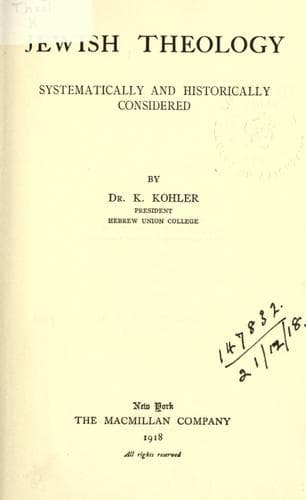
Jewish Theology, Systematically and Historically ConsideredKohler, Kaufmann
Religion
Jewish Theology, Systematically and Historically Considered
Kohler, Kaufmann
Judaism -- Doctrines
10. A complete change in the religious aspiration of the Jew was brought
about by the transformation of his political status and hopes in the
nineteenth century. The new era witnessed his admission in many lands to
full citizenship on an equality with his fellow-citizens of other faiths.
He was no longer distinguished from them in his manner of speech and
dress, nor in his mode of education and thought; he therefore necessarily
identified himself completely with the nation whose language and
literature had nurtured his mind, and whose political and social destinies
he shared with true patriotic fervor. He stood apart from the rest only by
virtue of his religion, the great spiritual heritage of his hoary past.
Consequently the hope voiced in the Synagogal liturgy for a return to
Palestine, the formation of a Jewish State under a king of the house of
David, and the restoration of the sacrificial cult, no longer expressed
the views of the Jew in Western civilization. The prayer for the
rebuilding of Jerusalem and the restoration of the Temple with its
priestly cult could no longer voice his religious hope. Thus the leaders
of Reform Judaism in the middle of the nineteenth century declared
themselves unanimously opposed to retaining the belief in a personal
Messiah and the political restoration of Israel, either in doctrine or in
their liturgy.(1225) They accentuated all the more strongly Israel’s hope
for a Messianic age, a time of universal knowledge of God and love of man,
so intimately interwoven with the religious mission of the Jewish people.
Harking back to the suffering Servant of the Lord in Deutero-Isaiah, they
transferred the title of Messiah to the Jewish nation. Reform Judaism has
thus accepted the belief that Israel, the suffering Messiah of the
centuries, shall at the end of days become the triumphant Messiah of the
nations.(1226)
Public-domain text, read in full here on John Shaqi.
Reviews
Reviews
No reviews yet
Be the first to share your thoughts on this work.
Elsewhere in the archive
Join the Discussion
Join the discussion
Sign in to leave a comment or review.
Sign InorCreate an account