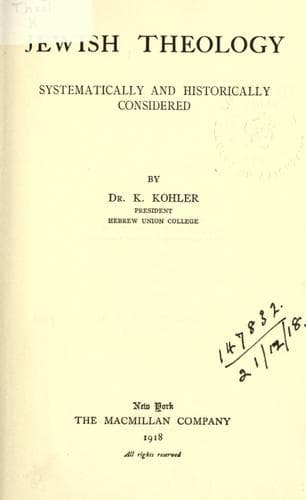
Jewish Theology, Systematically and Historically ConsideredKohler, Kaufmann
Religion
Jewish Theology, Systematically and Historically Considered
Kohler, Kaufmann
Judaism -- Doctrines
11. This view taken by reform Judaism is the logical outcome of the
political and social emancipation of the Jew in western Europe and
America. Naturally, it had no appeal to the Jew in the Eastern lands,
where he was kept apart by mental training, social habits and the
discrimination of the law, so that he regarded himself as a member of a
different nationality in every sense. Palestine remained the object of his
hope and longing in both his social and religious life. When modern ideas
of life began to transform the religious views and habits in many a
quarter, and terrible persecutions again aroused the longing of the
unfortunate sufferers for a return to the land of their fathers, the term
Zionism was coined, and the movement rapidly spread. It expressed the
purely national aims of the Jewish people, disregarding the religious
aspirations always heretofore connected with the Messianic hope. This term
has since become the watchword of all those who hope for a political
restoration of the Jewish people on Palestinian soil, as well as of others
whose longings are of a more cultural nature. Both regard the Jewish
people as a nation like any other, denying to it the specific character of
a priest-people and a holy nation with a religious mission for humanity,
which has been assigned to it at the very beginning of its history and has
served to preserve it through the centuries. On this account Zionism,
whether political or cultural, can have no place in Jewish theology. Quite
different is the attitude of religious Zionism which emphasizes the
ancient hopes and longings for the restoration of the Jewish Temple and
State in connection with the nationalistic movement.
12. Political Zionism owes its origin to the wave of Anti-Semitism which
rose as a counter-movement to the emancipation of the Jew, that alienated
many of the household of Israel from their religion. Thus it has the merit
of awakening many Jews upon whom the ancestral faith had lost its hold to
a sense of love and loyalty to the Jewish past. In many it has aroused a
laudable zeal for the study of Jewish history and literature, which should
bring them a deeper insight into, and closer identification with, the
historic character of Israel, the suffering Messiah of the nations, and
thus in time transform the national Jew into a religious Jew. The study of
Israel’s mighty past will, it is hoped, bring to them the conviction that
the power, the hope and the refuge of Israel is in its God, and not in any
territorial possession. We require a regeneration, not of the nation, but
of the faith of Israel, which is its soul.
Chapter LIV. Resurrection, a National Hope
Public-domain text, read in full here on John Shaqi.
Reviews
Reviews
No reviews yet
Be the first to share your thoughts on this work.
Elsewhere in the archive
Join the Discussion
Join the discussion
Sign in to leave a comment or review.
Sign InorCreate an account