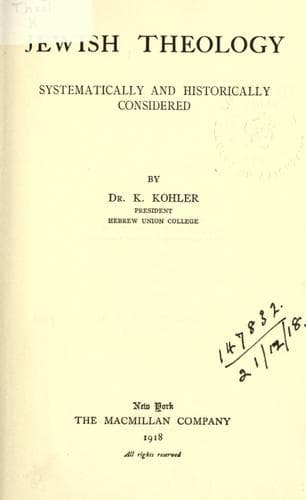
Jewish Theology, Systematically and Historically ConsideredKohler, Kaufmann
Religion
Jewish Theology, Systematically and Historically Considered
Kohler, Kaufmann
Judaism -- Doctrines
3. In this hope for resurrection at the end of days the leading thought is
that the prophecies which have been unfulfilled during the lifetime of the
pious, and particularly the martyrs, shall be realized in the world to
come.(1236) In the oldest apocalyptic writings this life of the future is
still conceived as earthly bliss, inasmuch as the writers think only of
the Messianic time of national glory, depicted in such glowing colors by
the prophets. Unbounded richness of the soil and numerous offspring,
abundant treasures brought by remote nations and their rulers, peace and
happiness far and wide—such are the characteristics of the Messianic age.
In order that the dead may share in all this, it is to be preceded by the
resurrection and the great _Day of Judgment_ in the valley of Jehoshaphat
or Gehinnom (Gehenna), where the righteous are to be singled out to
participate in the realm of the Messiah.(1237) As a national prospect the
Messianic hope was based upon the passage in Deutero-Isaiah: “Thy people
also shall be all righteous, they shall inherit the land forever.”(1238)
Consequently an ancient Mishnah taught that “All Israel shall have a share
in the world to come.”(1239) In fact, the term “inherit the land” was used
as late as the Mishnah to express the idea of sharing in the future life;
so also in the New Testament, where the resurrection was expected before
the coming of the kingdom of the Messiah.(1240)
4. The logical assumption was, accordingly, that only the dead of the holy
land should enjoy the resurrection. The prophetic verses were cited: “I
will set glory in the land of the living,”(1241) and “He that giveth
breath to the people upon it, and spirit to them that walk therein,”(1242)
and were interpreted in the sense that God would restore the breath of
life only to those buried in the holy land.(1243) Likewise the verse of
the Psalmist, “I shall walk before the Lord in the land of the living,”
was referred to Palestine, as the land where the dead shall awaken to a
new life.(1244) Hence the rabbis held the strange belief that when the
great heavenly trumpet is sounded to summon all the tribes of Israel from
the ends of the earth to the holy land,(1245) those who have been buried
outside of Palestine must pass through cavities under the earth, until
they reach the soil where the miracle of the resurrection will be
performed.(1246) It has, therefore, become a custom of the pious among the
Orthodox to this very day, in case they could not bury the dead in
Palestine, to put dust of the holy land beneath their head, that they
might arise wherever they were buried.
Public-domain text, read in full here on John Shaqi.
Reviews
Reviews
No reviews yet
Be the first to share your thoughts on this work.
Elsewhere in the archive
Join the Discussion
Join the discussion
Sign in to leave a comment or review.
Sign InorCreate an account