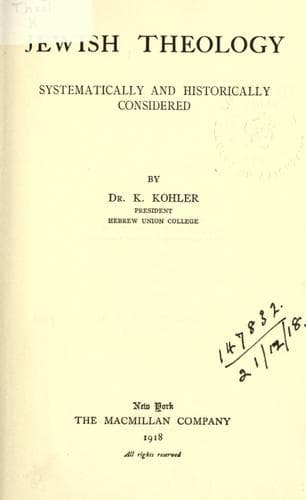
Jewish Theology, Systematically and Historically ConsideredKohler, Kaufmann
Religion
Jewish Theology, Systematically and Historically Considered
Kohler, Kaufmann
Judaism -- Doctrines
5. We may take it for granted that this naïve conception of the
resurrection could not be permanent, and so was modified to include a
double resurrection: the first, national, to usher in the Messianic
kingdom, and the other, universal, to usher in the everlasting life of the
future. The former offered scant room for the heathen world, at best only
for those who had actually joined the ranks of Judaism; the latter,
however, included the last judgment for all souls and thus opened the way
for the salvation of the righteous among the nations as well as the people
of Israel. At this point the conception of resurrection led to higher and
more spiritual ideas, as has been shown in Chapter XLIII.
6. However, the belief in the resurrection of the body, though expressed
in the ancient liturgy, is in such utter contradiction to our entire
attitude toward both science and religion, that it may be considered
obsolete for the modern Jew. Orthodoxy, which clings to it in formal
loyalty to tradition, regards it as a miracle which God will perform in
the future, exactly like the many Biblical miracles which defy reason.
7. The Zionist movement has given many Jews a new attitude toward the
national resurrection of Israel. The nationalists expect the Jewish nation
to awaken from a sleep of eighteen hundred years to new greatness in its
ancient home, not as a religious, but as a political body, and in
renouncing all allegiance to the priestly mission of Israel and its
ancestral faith they are as remote from genuine Orthodoxy as from Reform
Judaism. They assert that the soul of the Jewish people requires a
national body rooted in its ancient soil in order that it may fulfill its
appointed task among the nations; they even go so far as to declare all
the achievements brought about by the assimilation of the culture of the
surrounding nations to be a deterioration of the genuine character of the
Jewish nation. The fact is that, as in nature there is nowhere a
resurrection of the dead but an ever renewed regeneration of life, so is
the history of the Jew and of Judaism a continuous process of regeneration
manifested at every great turning-point of history, when the ideas and
cultural elements of a new civilization exert their powerful influence on
life and thought. There never was, nor will be an exclusively Jewish
culture. It is the wondrous power of assimilation of the Jew which ever
created and fashioned his culture anew. That which constitutes the
peculiarity of the Jew and his life force is his religion fostered through
the ages, preserved amidst the most antagonistic influences and hostile
environments, and ever rejuvenated by its unique universalistic spirit
when revived by contact with kindred movements. To maintain and propagate
this, his religion in all lands and amidst all civilizations, is the task
assigned to him by Providence, until God’s Kingdom has been established
all over the globe.
Chapter LV. Israel and the Heathen Nations
Public-domain text, read in full here on John Shaqi.
Reviews
Reviews
No reviews yet
Be the first to share your thoughts on this work.
Elsewhere in the archive
Join the Discussion
Join the discussion
Sign in to leave a comment or review.
Sign InorCreate an account