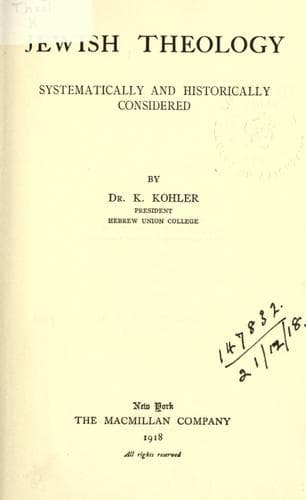
Jewish Theology, Systematically and Historically ConsideredKohler, Kaufmann
Religion
Jewish Theology, Systematically and Historically Considered
Kohler, Kaufmann
Judaism -- Doctrines
2. Nothing was more remote from ancient Israel than the hatred of the
stranger or hostility to other nations, so often attributed to it.(1251)
In the time of the patriarchs and under the monarchy, the Hebrews fostered
a spirit of friendly intercourse with their neighbors, which was often
confirmed by peaceful alliances.(1252) Of course, during war time the
spirit of hostility had full sway, particularly as ancient warfare imposed
a relentless ban upon both booty and human life among the vanquished. But
even then the kings of Israel were called compassionate also toward their
enemies when compared with other rulers.(1253) Indeed, the code of Israel
is distinguished from all other codes of antiquity by mildness and tender
compassion. On the other hand, the God of justice, revealed through Amos,
Isaiah, Jeremiah, and Habakkuk, punishes Israel and the nations
impartially on account of their moral transgressions.(1254) He avenges
acts of treachery, even when committed against pagan tyrants. “Shall not
the Judge of all the earth do justly?”(1255) Such is the recurrent thought
that governs Israel, demanding the same standard of judgment for Israelite
and stranger.
3. The simple sense of justice inherent in the Jewish people admits so
little difference between our own God-consciousness and that of others,
that Scripture represents the Philistine King Abimelech as receiving a
warning from Abraham’s God *JHVH*.(1256) As the Bible holds up Job, the
Bedouin Sheik, as the pattern of a blameless servant of God and true lover
of mankind,(1257) so the Talmud cites the Philistine Dama ben Nethina as
an example of filial piety.(1258) Altogether, the merits of the heathen
receive their full measure of appreciation throughout Jewish
literature,(1259) even though a narrow dissenting view occurs now and
then.(1260)
4. Still from the very beginning a tendency to relentless harshness
existed in one direction, when the pure worship of Israel’s one and only
God was endangered. The early Book of the Covenant forbade every alliance
with idolatrous nations,(1261) and the Deuteronomic Code made this more
stringent by prohibiting intermarriage and even the toleration of
idolaters in the land, lest they seduce the people of God to turn away
from Him.(1262) The Pharisean leaders, the founders of Rabbinism, went
still further by placing an interdict upon eating with the heathen or
using food and wine prepared by them, thus aiming at a complete separation
from the non-Jewish world.(1263)
Public-domain text, read in full here on John Shaqi.
Reviews
Reviews
No reviews yet
Be the first to share your thoughts on this work.
Elsewhere in the archive
Join the Discussion
Join the discussion
Sign in to leave a comment or review.
Sign InorCreate an account