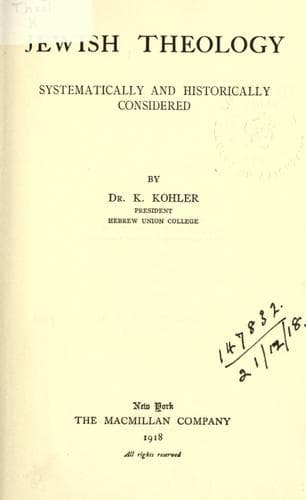
Jewish Theology, Systematically and Historically ConsideredKohler, Kaufmann
Religion
Jewish Theology, Systematically and Historically Considered
Kohler, Kaufmann
Judaism -- Doctrines
The contrast between Judaism and heathenism was further heightened by the
view of the prophets and psalmists, showing that the great nations were
the very embodiment of idolatrous iniquity, murderous violence and sexual
impurity, a world of arrogance and pride, defying God and doomed to
perdition, because they opposed the kingdom of God proclaimed by
Israel.(1264) Henceforth the term “the nations” (_goyim_) was taken by the
religious as meaning the wicked ones, who would not be able to stand the
divine judgment in the future life, but would go down to Sheol, or
Gehenna, to fall a prey to everlasting corruption, to the fire that is
never quenched.(1265)
5. Yet such a wholesale condemnation could not long be maintained; it was
too strongly contradicted in principle by the prophets and Psalmists, and
quite as much by the apocalyptic writers and Haggadists of later times.
The book of Jonah testifies that Israel’s God sent His prophet to the
heathen of Nineveh to exhort them to repentance, that they might obtain
forgiveness and salvation like repentant Israel.(1266) Heathenism is
doomed to perish, not the heathen; they are to acknowledge the heavenly
Judge in their very punishments and return to Him. Such is the conclusion
of all the exhortations of the prophets predicting punishment to the
nations. Moreover, those heathen who escape the doom of the world-powers
are to proclaim the mighty deeds of the Lord to the utmost lands. Nay,
according to the grand vision of the exilic seer, among the many nations
that shall assemble at the end of days to worship the Lord in Zion, select
ones will be admitted to the priesthood with the sons of Aaron.(1267) The
name _Hadrak_, understood as “he who bringeth back,” suggested itself to
the rabbis as a title of the Messiah, the converter of the heathen
nations.(1268) So in both the Talmud and the Sibylline books(1269) Noah is
represented as a preacher of repentance to the nations before the flood,
and accordingly the latter book adjures the Hellenic world to repent of
their sinful lives before they would be overwhelmed by the flood of fire
at the great judgment day. In the same spirit the Haggadists tell that God
sent Balaam, Job, and other pious men as prophets of the heathen to teach
them the way of repentance.(1270) And the rabbis actually say that, if the
heathen nations had not refused the Torah when the Lord offered it to them
at Sinai, it would have been the common property of all mankind.(1271)
Public-domain text, read in full here on John Shaqi.
Reviews
Reviews
No reviews yet
Be the first to share your thoughts on this work.
Elsewhere in the archive
Join the Discussion
Join the discussion
Sign in to leave a comment or review.
Sign InorCreate an account