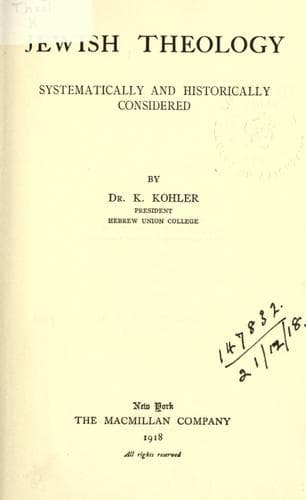
Jewish Theology, Systematically and Historically ConsideredKohler, Kaufmann
Religion
Jewish Theology, Systematically and Historically Considered
Kohler, Kaufmann
Judaism -- Doctrines
high inspiration that it incites to the highest virtue, the firmest
loyalty, and the greatest love for truth and justice. Judaism, knowing no
such thing as original sin, points with pride instead to hereditary
virtue, deriving an inexhaustible source of blessing from its historical
continuity of four thousand years.
Chapter LVI. The Stranger and the Proselyte
1. Among all the laws of the Mosaic Code, that which has no parallel in
any other ancient code is the one enjoining justice, kindness and love
toward the stranger. The Book of the Covenant teaches: “And a stranger
shall thou not wrong, neither shalt thou oppress him; for ye were
strangers in the land of Egypt,”(1296) and “A stranger shalt thou not
oppress; for ye know the heart of a stranger, seeing ye were strangers in
the land of Egypt.” The Deuteronomic writer lays special stress on the
fact that Israel’s God, “who regardeth not persons nor taketh bribes, doth
execute justice for the fatherless and the widow, and loveth the stranger,
in giving him food and raiment.” He then concludes: “Love ye therefore the
stranger; for ye were strangers in the land of Egypt.”(1297) The Priestly
Code goes still further, granting the stranger the same legal protection
as the native.(1298)
2. We would, however, misunderstand the spirit of all antiquity, including
ancient Israel, if we consider this as an expression of universal love for
mankind and the recognition of every human being as fellow-man and
brother. Throughout antiquity and during the semi-civilized Middle Ages, a
stranger was an enemy unless he became a guest. If he sought protection at
the family hearth or (in the Orient) under the tent of a Sheik, he thereby
entered into a tutelary relation with both the clan or tribe and its
deity. After entering into such a relation, temporary or permanent, he
became, in the term which the Mosaic law uses in common with the general
Semitic custom, a _Ger_ or _Toshab_, “sojourner” or “settler,” entitled to
full protection.(1299) This relation of dependency on the community is
occasionally expressed by the term: “thy stranger that is within thy
gates.”(1300) Such protection implied, in turn, that the _Ger_ or
_protegé_ owed an obligation to the tribe or community which shielded him.
He stood under the protection of the tribal god, frequently assumed his
name, and thus dared not violate the law of the land or of its deity, lest
he forfeit his claim to protection.
Public-domain text, read in full here on John Shaqi.
Reviews
Reviews
No reviews yet
Be the first to share your thoughts on this work.
Elsewhere in the archive
Join the Discussion
Join the discussion
Sign in to leave a comment or review.
Sign InorCreate an account