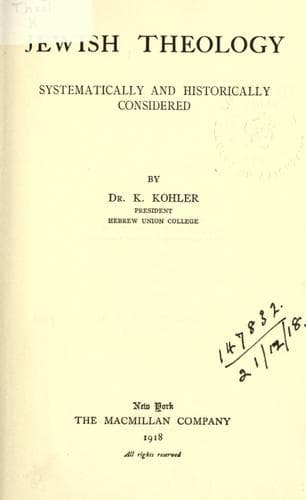
Jewish Theology, Systematically and Historically ConsideredKohler, Kaufmann
Religion
Jewish Theology, Systematically and Historically Considered
Kohler, Kaufmann
Judaism -- Doctrines
As a matter of fact, the Code of Law aimed to separate Israel and the
nations in order to avoid the crude worship of idols, animals and stars
practiced by the heathen of antiquity. It was not framed for masters like
Socrates, Buddha, and Confucius, with their lofty moral views and their
claims upon humanity. The God who revealed himself to Abraham, Job, Enoch,
and Balaam, as well as to Moses and Isaiah, spoke to them also, and the
wise ones of Israel have ever hearkened to their inspiring lessons. Their
words are echoed in Jewish literature together with Solomon’s words of
wisdom. Plato, Plotinus, and Aristotle received the most friendly
hospitality from the rabbinic philosophers and mystic writers of Jewry,
and so Buddhist sayings and views penetrated into Jewish ethics and
popular teachings. Both the Jew and his literature are cosmopolitan, and
Judaism never withholds its appreciation of the merits of the heathen
world.(1291)
11. We must especially emphasize one claim of the Jewish people above
other nations which the rabbis call _zekuth aboth_, “the merit of the
fathers,” and which we may term “hereditary virtue.” The election of
Israel, in spite of its own lack of merit, is declared in Deuteronomy and
elsewhere to be due to the merit of the fathers, with whom God concluded
His covenant in love.(1292) The promise is often repeated that God will
ever remember His covenant with the fathers and not let the people perish,
even though their sins were great; therefore the rabbis assumed that the
patriarchs had accumulated a store of merit by their virtues which would
redound before God to the benefit of their descendants, supplementing
their own weaknesses.(1293) This merit or righteousness of the fathers
formed a prominent part of the hope and prayer, nay, of the whole
theological system of the Jewish people. They regarded the patriarchs and
all the great leaders of the past as patterns of loyalty and love for God,
so that, according to the Midrash, Israel might say in the words of the
Shulamite: “Black am I” considering my own merit, “but comely” when
considering the merit of the fathers.(1294) Whether this store of merit
would ever be exhausted is a matter of controversy among the rabbis. Some
referred to God’s own words that He will ever remember His covenant with
the fathers; others pointed to the verse in Deutero-Isaiah: “For the
mountains may depart, and the hills be removed; but My kindness shall not
depart from thee, neither shall My covenant of peace be removed,” which
they interpreted symbolically to mean: when the merit of the patriarchs
and matriarchs of Israel is exhausted, God’s mercy and compassion for
Israel will be there never to depart.(1295) Translated into our own mode
of thinking, this merit of the fathers claimed for Israel signifies the
unique treasure of a spiritual inheritance which belongs to the Jew. This
inheritance of thousands of years provides such rare examples and such
Public-domain text, read in full here on John Shaqi.
Reviews
Reviews
No reviews yet
Be the first to share your thoughts on this work.
Elsewhere in the archive
Join the Discussion
Join the discussion
Sign in to leave a comment or review.
Sign InorCreate an account