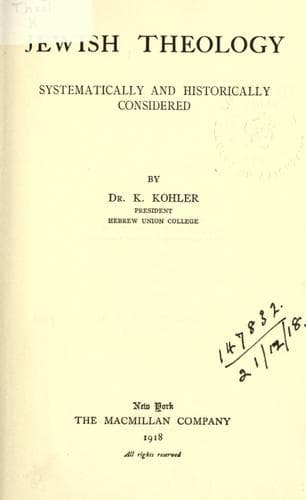
Jewish Theology, Systematically and Historically ConsideredKohler, Kaufmann
Religion
Jewish Theology, Systematically and Historically Considered
Kohler, Kaufmann
Judaism -- Doctrines
around him, a disloyalty and weakness of character unworthy of a son of
Abraham, the faithful. Since the beginning of the new era in the time of
Mendelssohn, apostasy has made great inroads upon the numerical and
intellectual strength of Judaism, especially among the upper classes. It
is no longer, however, of an aggressive character, but rather a result of
the lack of Jewish self-respect and religious sentiment, against which
measures tending to a revival of the Jewish spirit are being taken more
and more. The Jews are called by the rabbis “the faithful sons of the
faithful.” The apostate must be made to feel that he is of a lower type,
since he has become a deserter from the army of the battlers for the Lord,
the Only One God of Israel.
Chapter LVII. Christianity and Mohammedanism, the Daughter-Religions Of
Judaism
1. “It shall come to pass on that day that living waters shall go out from
Jerusalem; half of them toward the eastern sea and half of them toward the
western sea.... And the Lord shall be King over all the earth; in that day
shall the Lord be One, and His name one.”(1377) These prophetic words of
Zechariah may be applied to the two great world-religions which emanated
from Judaism and won fully half of the human race, as it exists at
present, for the God of Abraham. Though they have incorporated many
non-Jewish elements in their systems, they have spread the fundamental
truths of the Jewish faith and Jewish ethics to every part of the earth.
Christianity in the West and Islam in the East have aided in leading
mankind ever nearer to the pure monotheistic truth. Consciously or
unconsciously, both found their guiding motive in the Messianic hope of
the prophets of Israel and based their moral systems on the ethics of the
Hebrew Scriptures. The leading spirits of Judaism recognized this,
declaring both the Christian and Mohammedan religions to be agencies of
Divine Providence, intrusted with the historical mission of coöperating in
the building up of the Messianic Kingdom, thus preparing for the ultimate
triumph of pure monotheism in the hearts and lives of all men and nations
of the world. These views, voiced by Jehuda ha Levi, Maimonides, and
Nahmanides,(1378) were reiterated by many enlightened rabbis of later
times. These point out that both the Christian and Mohammedan nations
believe in the same God and His revelation to man, in the unity of the
human race, and in the future life; that they have spread the knowledge of
God by a sacred literature based upon our Scripture; that they have
retained the divine commandments essentially as they are phrased in our
Decalogue; and have practically taught men to fulfill the Noahitic laws of
humanity.(1379) On account of the last fact the medieval Jewish
authorities considered Christians to be half-proselytes,(1380) while the
Mohammedans, being pure monotheists, were always still closer to Judaism.
Public-domain text, read in full here on John Shaqi.
Reviews
Reviews
No reviews yet
Be the first to share your thoughts on this work.
Elsewhere in the archive
Join the Discussion
Join the discussion
Sign in to leave a comment or review.
Sign InorCreate an account