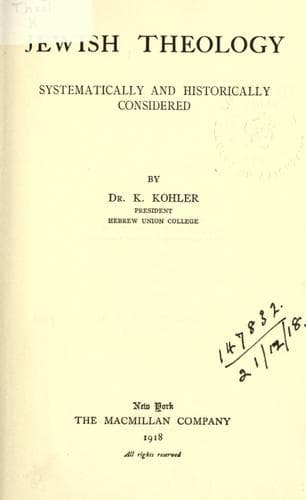
Jewish Theology, Systematically and Historically ConsideredKohler, Kaufmann
Religion
Jewish Theology, Systematically and Historically Considered
Kohler, Kaufmann
Judaism -- Doctrines
2. In general, however, rabbinic Judaism was not in a position to judge
Christianity impartially, as it never learned to know primitive
Christianity as presented in the New Testament. We see no indication in
either the oldest Talmudic sources or Josephus that the movement made any
more impression in Galilee or Jerusalem than the other Messianic
agitations of the time. All that we learn concerning Jesus from the rabbis
of the second century and later is that magic arts were practiced by him
and his disciples who exorcised by his name; and, still worse, that the
sect named after him was suspected of moral aberrations like a few Gnostic
sects, known by the collective name of _Minim_, “sectarians.”(1381) As a
matter of fact, the early Church was chiefly recruited from the Essenes
and distinguished itself little from the rest of the Synagogue. Its
members, who are called Judæo-Christians, continued to observe the Jewish
law and changed their attitude to it only gradually.(1382) Matters took a
different turn under the influence of Paul, the apostle to the heathen,
who emphasized the antinomian spirit; the Judæo-Christian sects were then
pushed aside, hostility to Judaism became prominent, and the Church strove
more and more for a _rapprochement_ with Rome.(1383) Then the rabbis awoke
to the serious danger to Judaism from these heretics, _Minim_, when after
the tragic downfall of the Jewish nation they grew to world-power as
allies of the Roman Empire. Thus Isaac Nappaha, a Haggadist of the fourth
century, declared: “The turning point for the advent of the Messiah, the
son of David, will not come until the whole (Roman) Empire has been
converted to Christianity (_Minuth_).”(1384) This is supplemented by the
Babylonian Rabbah, who plays with a Biblical phrase, saying: “Not until
the whole (Roman) world has turned to the Son (of God).”(1385) Henceforth
Christian Rome was termed _Edom_, like pagan Rome from the days of Herod
the Idumean. In fact, her imperial edicts showed the fratricidal hatred of
Esau, with hardly a trace of the professed religion of love. No wonder the
Haggadists identified Rome with the Biblical “Boar of the forest,” and
waited impatiently for the time when she would have to give up her rule as
the fourth world-empire to the people of God, ushering in the Messianic
era.(1386)
Public-domain text, read in full here on John Shaqi.
Reviews
Reviews
No reviews yet
Be the first to share your thoughts on this work.
Elsewhere in the archive
Join the Discussion
Join the discussion
Sign in to leave a comment or review.
Sign InorCreate an account